Introduction
“A horse, a horse, my kingdom for a horse!”
– “Richard III”, Shakespeare
For my mother’s birthday this year I have decided to finalize and publish research into her maternal ancestry.
There are platforms such as 23andMe which provide you with insights into your ancestry composition.
These platforms mainly offer you high-level information based on your DNA sequencing and known ethnographical, statistical and historical data, cross-referencing your data with the huge datasets already known to the scientists.
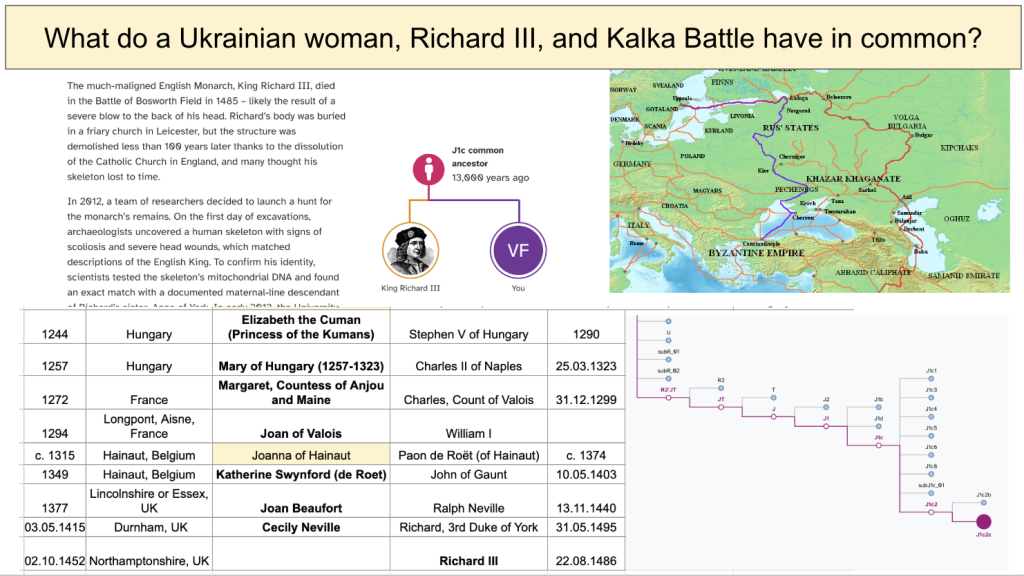
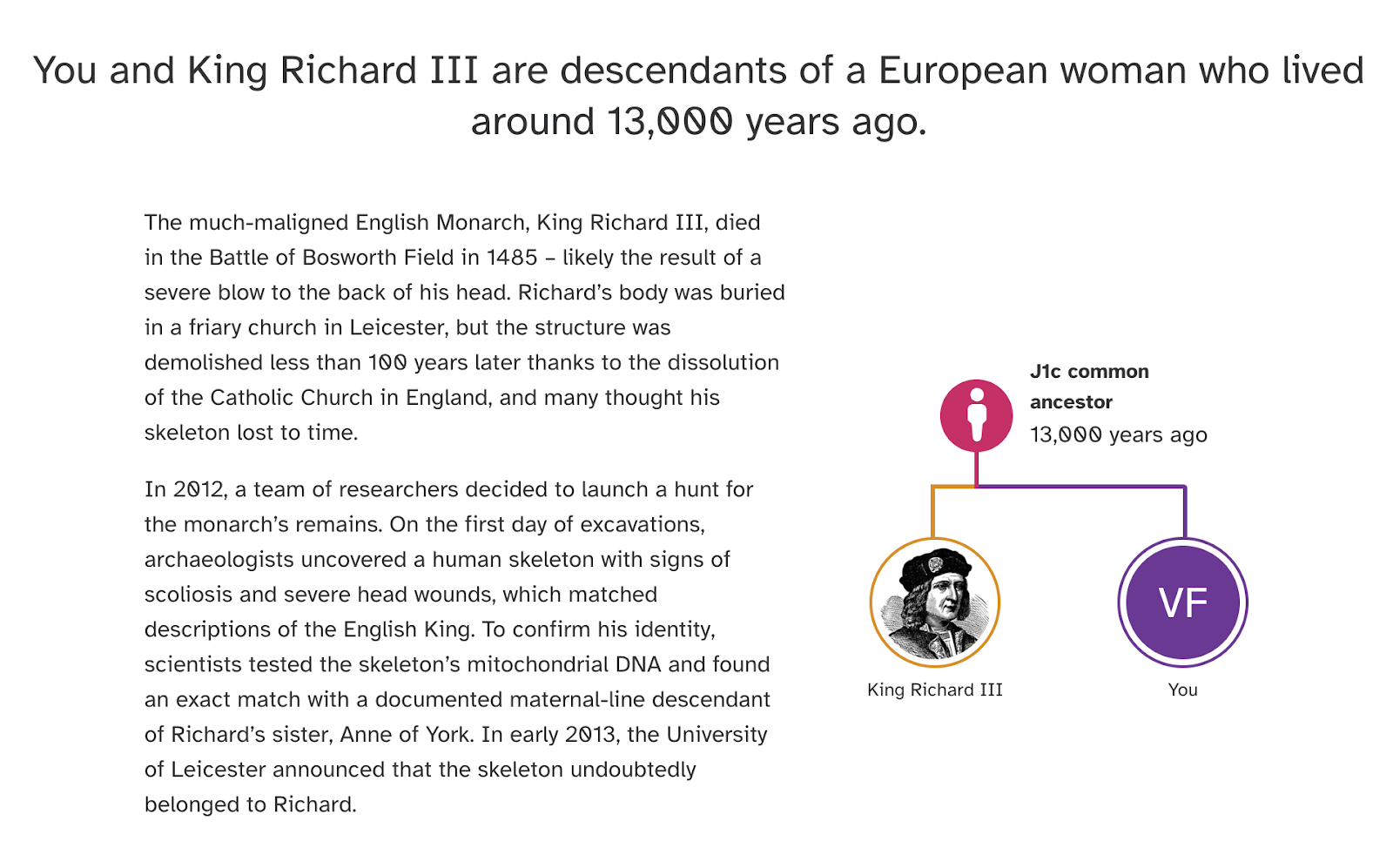
They also provide you with some interesting facts or rather teasers. Like in my mother’s, saying that she shares the same piece of DNA (a haplogroup) with King Richard III of England.
This inspired my research to clarify what this means and to see whether I could discover something interesting in relation to our lineage. While the Richard III connection turned out to be not as exciting as they make it sound, I did discover new knowledge, a number of very interesting facts from genealogy and history, which I find worthwhile to share.
Bonus content: I may have accidentally established a link between Richard III and the nomadic people who lived in the territory of modern Ukraine.
This publication is my attempt to put everything together in a format close to “pop science” so that it could be interesting and useful for others as well.
The following are the topics covered and questions answered in this publication.
Outline
- What haplogroup is and who is Mitochondrial Eve – the pra-mother of all living humans.
- What sharing a haplogroup with a famous person means. Descendants or a common distant ancestor? How many people now alive share the same haplogroup as Richard III?
- Is the Ukraine connection unusual for J1c2c? How our ancestors have migrated across Western Asia, Europe and Scandinavia during neolithic farming and viking times.
- What Richard III could possibly have in common with Kyivan Rus’, Cuman people or Hungary.
- Conclusions
What haplogroup is and who is Mitochondrial Eve – the pra-mother of all living humans.
Simply put, haplogroups are the well studied parts of our DNA that allow us to track our lines of descent.
At certain points in human history (approximately every 3,500 years) haplogroups mutate or split into subsets and researchers know approximately where and when each mutation has happened.
That knowledge allows for each of us, knowing our haplogroups, to predict where our genetic lineage is coming from, backward tracking the history of our ancestors through the nested hierarchy of the haplogroups.
Now, the best studied types of haplogroups in humans are Y-chromosome (Y-DNA) and mitochondrial DNA (mtDNA). Each of these is used to define genetic populations and are widely used in evolutionary biology studies.
Y-DNA is passed from father to son, while mtDNA is only passed from mother to offspring of both sexes.
Importantly, these haplogroups don’t recombine which means that for each of us, we can clearly trace our matrilineal line (from our mother to her mother to her mother and so on) using mtDNA, and similarly for males the patrilineal line can be traced using Y-DNA.
Who is Mitochondrial Eve?
This, in turn, brings us to the fact that there once lived a woman who was a most recent female ancestor of ALL LIVING HUMANS according to our mtDNA traces. Scientists call her “Mitochondrial Eve”. She is estimated to have lived around 155,000 years ago.
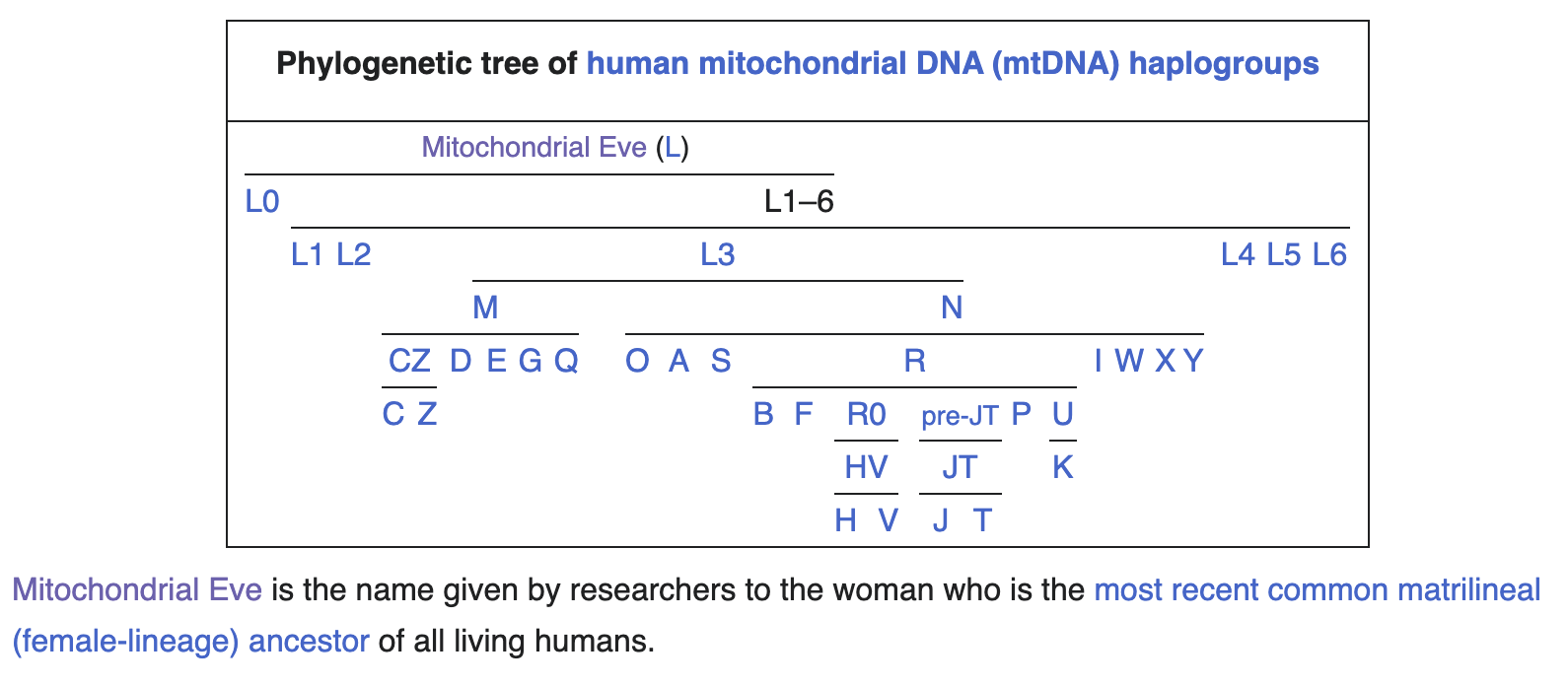
Source: https://en.wikipedia.org/wiki/Haplogroup
Hot things within
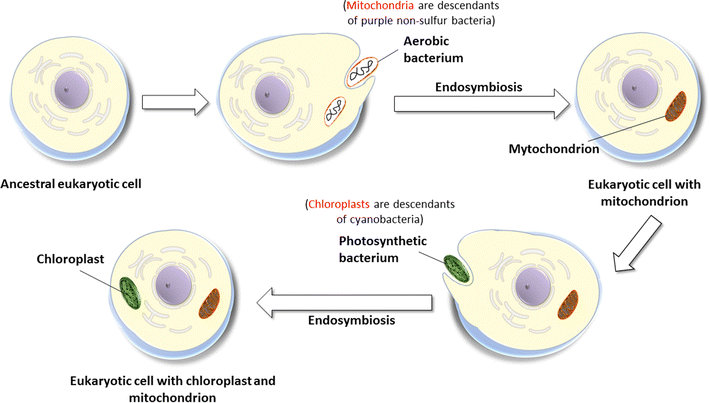
By the way, Mitochondria are super interesting on their own. The reason its chromosomes do not recombine making them a useful data marker for our mtDNA tracing purposes is due to the fact that these organelles in our bodies keep their own set of chromosomes and have a double membrane. There is a theory that mitochondria once were external bacteria who evolved into a symbiotic relationship with their hosts and thus eventually became a part of our bodies. Mitochondria DNA is normally inherited from mothers only as the sperm’s mitochondria is destroyed during conception. This is why mtDNA is used for maternal lineage tracing.
(source: https://www.mda.org/disease/mitochondrial-myopathies/causes-inheritance).
In any case, mitochondria are very important as they are responsible for energy production in our bodies and now we also know that they are super helpful in tracing our maternal lineage.
Was there an Adam too?
There is indeed such a concept as Y-chromosomal Adam too and that person is estimated to have lived around 200,000 to 300,000 years ago.
You may have noticed that, according to these estimations, the genetic “Adam” and “Eve” have each lived during different times. Indeed, these individuals have little to do with Biblical Adam and Eve. They are just the most recent common ancestors of ours (all humans) that can be tracked using the specific types of genetic traits. Also they do not correspond to a population “bottleneck” meaning they by all means were not the only living humans of their gender at the given time. A lot of humans, estimated in the tens of thousands, were their contemporaries.
So Mitochondrial Eve is simply the person who by chance has had an unbroken line of daughters leading to all living humans and similar is true for the Y-chromosomal Adam with the line of sons. So it should come as no surprise that those were people living at different times and also that Mitochondrial Eve and Y-chromosomal Adam will shift from time to time as certain lineages die out. As Richard Dawkins has put it, life is a river of genes flowing through geological time.
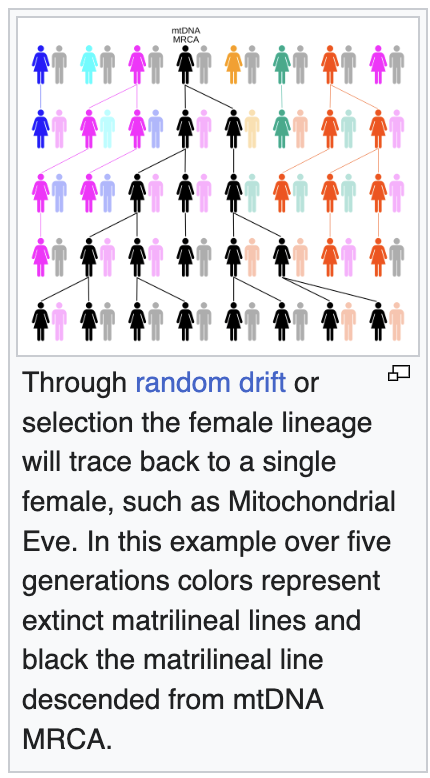
Source: https://en.wikipedia.org/wiki/Mitochondrial_Eve
By the way, there is also a concept of MRCA (Most Recent Common Ancestor) a.k.a. Last Common Ancestor (LCA) for all humans without the limiting factor of mtDNA or Y-DNA. So basically a single person with a high reproductive success who managed to end up in the lineage of all living humans. Some scientists believe this person has lived much more recently, as close as 2,000 to 5,000 years ago:
“A study by mathematicians Joseph T. Chang, Douglas Rohde and Steve Olson used a theoretical model to calculate that the MRCA may have lived remarkably recently, possibly as recently as 2,000 years ago.”
Source: https://en.wikipedia.org/wiki/Most_recent_common_ancestor
To summarize, now we understand that using specific types of human chromosomes we can accurately trace our ancestry over many thousands of years, and that for females the best way to do this is the mitochondrial DNA or maternal haplogroup.
Richard III thing. What sharing a haplogroup with a famous person means.
This research was inspired by the following information shown by 23andme in my mother’s, Mrs Vira Filatova, online profile:
Source: 23andMe, personal profile of Mrs Vira Filatova
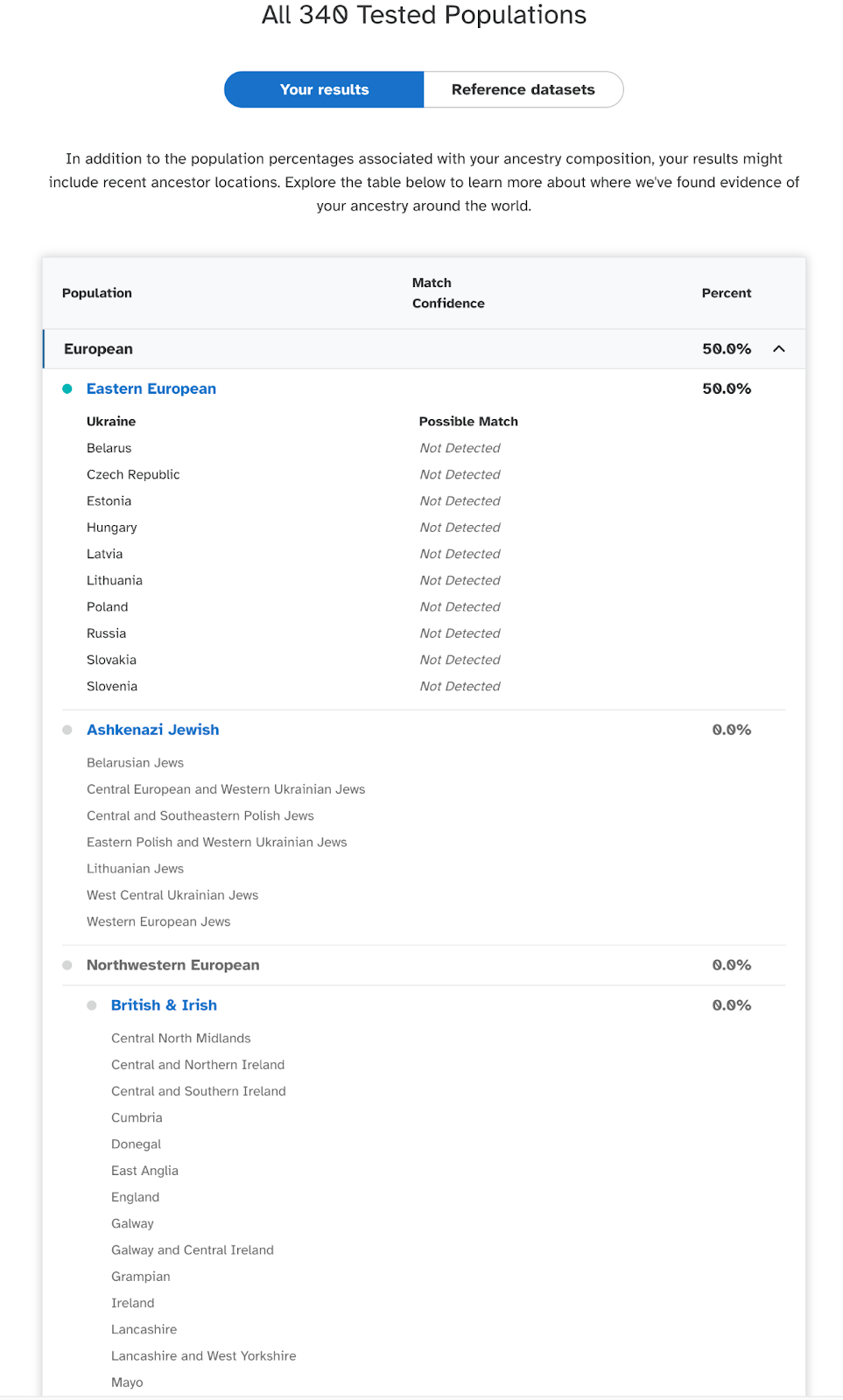
At the same time, for my mother the platform has stated that she has 0% of British and Irish descendancy:
Source: 23andMe, personal profile of Mrs Vira Filatova
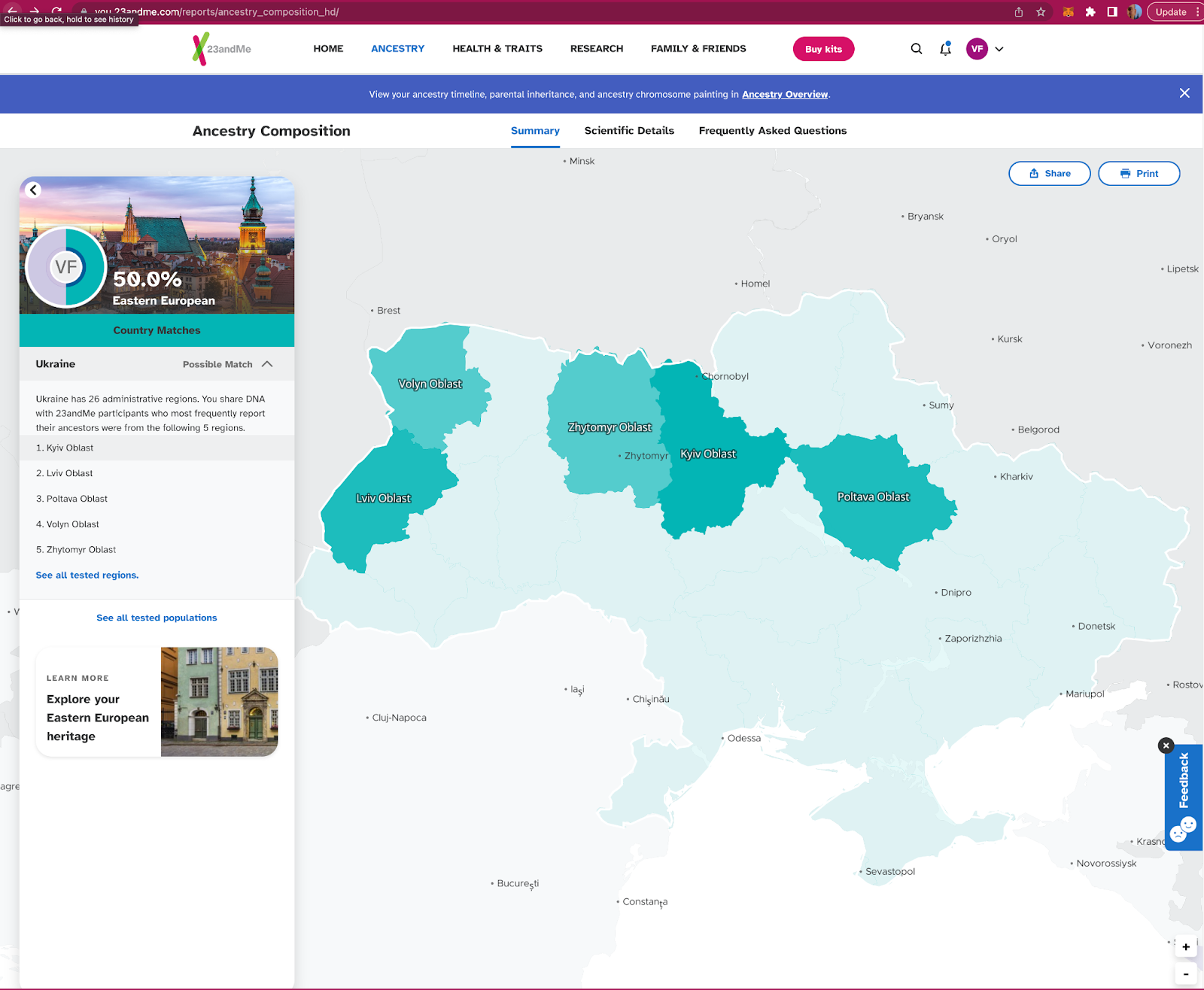
While at the same time we can clearly see that her mother, i.e. 50% of the DNA is clearly tied to Eastern European, specifically Ukrainian, going as precise as being attributed to the regions of Poltava, Kyiv, Zhytomyr, Lviv and Volyn.
Source: 23andMe, personal profile of Mrs Vira Filatova
So on one hand, Mrs Filatova through her mother shows no ancestry of British or Irish genetics, at the same time the Richard III connection comes through mtDNA haplogroup, which can only be through the maternal lineage.
Let’s find out whether we have discovered something contradictory, or whether this is normal. To clarify this, we need to understand how strong or unique sharing the same haplogroup with Richard III is.
How unique is it to share the same haplogroup as Richard III? Would all j1c haplogroup people be his relatives?
Let’s start with the “relatives” thing first. From ancient literature (nod to the Bible, in particular Genesis), we may have already gotten used to the fact that there was once a first pra-woman named Eve. And as we know from science, also covered in the previous chapter, there are scientifically proven facts that:
- There was a Mitochondrial Eve – a common maternal ancestor to all living humans who lived around 155,000 years ago.
- There was an Y-DNA Adam – a common paternal ancestor to all living humans who lived around 250,000 years ago.
- Less precisely dated by science, but a more recent common ancestor for all living humans has likely lived between 2,000 to 10,000 years ago.
So good news everyone – all of us including you, the reader, are the relatives of Richard III!
Moreover, all living humans are relatives too coming from the same ancestor somewhere earlier or later in the lineage. This, I hope, does not come as a surprise..
Descendants or a common distant ancestor?
This, of course, doesn’t mean that we are all descendants of Richard III. This merely means that we have a common distant ancestor who lived waaay before Richard III.
Now, some of us, such as my mother, are lucky to have retained either a Y-DNA or a mtDNA haplogroup that provides a scientifically proven way to confirm they have a common ancestor with a certain famous person such as RIchard III.
Now, to find out what that means and how rare of occurrence that is, we should dig a bit deeper into haplogroup J1c2c.
How unique haplogroup J1c2c is?
Here we should probably ask: OK when did the J1c2c split happen or how many people living now could show off the same haplogroup?
Note: In this section and the following two sections I provide excerpts from literature that provide us with the answers. Feel free to skim through and skip to the conclusions of this chapter.
“When the search for Richard III was announced, the University of Leicester received numerous enquiries from people claiming to be related to the late monarch. This is only to be expected: given the number of generations and the large families common in previous centuries, Richard’s mother Cecily Neville could (mathematically) have several million direct descendants today! As Professor Turi King from the University’s Department of Genetics succinctly points out: “We are all related to Richard III. It’s just a matter of degree.””
“Building on this earlier work, Professor Schürer’s task was to locate documentary evidence (in the National Archives and elsewhere) for every link in the chain connecting Cecily Neville, Duchess of York (1415-1495) to Michael Ibsen, furniture maker (born 1957). Wills, baptism registers, certificates of birth and marriage and even the passenger list for the SS Mauretania, which carried Joy Brown and her mother to Canada in 1948, together provide inarguable documentary evidence of an unbroken female line of descent.”
Source: https://le.ac.uk/-/media/uol/docs/richard-iii/genetics/richard-iii-timeline-genealogy-and-genetics.pdf University of Leicester, 2013
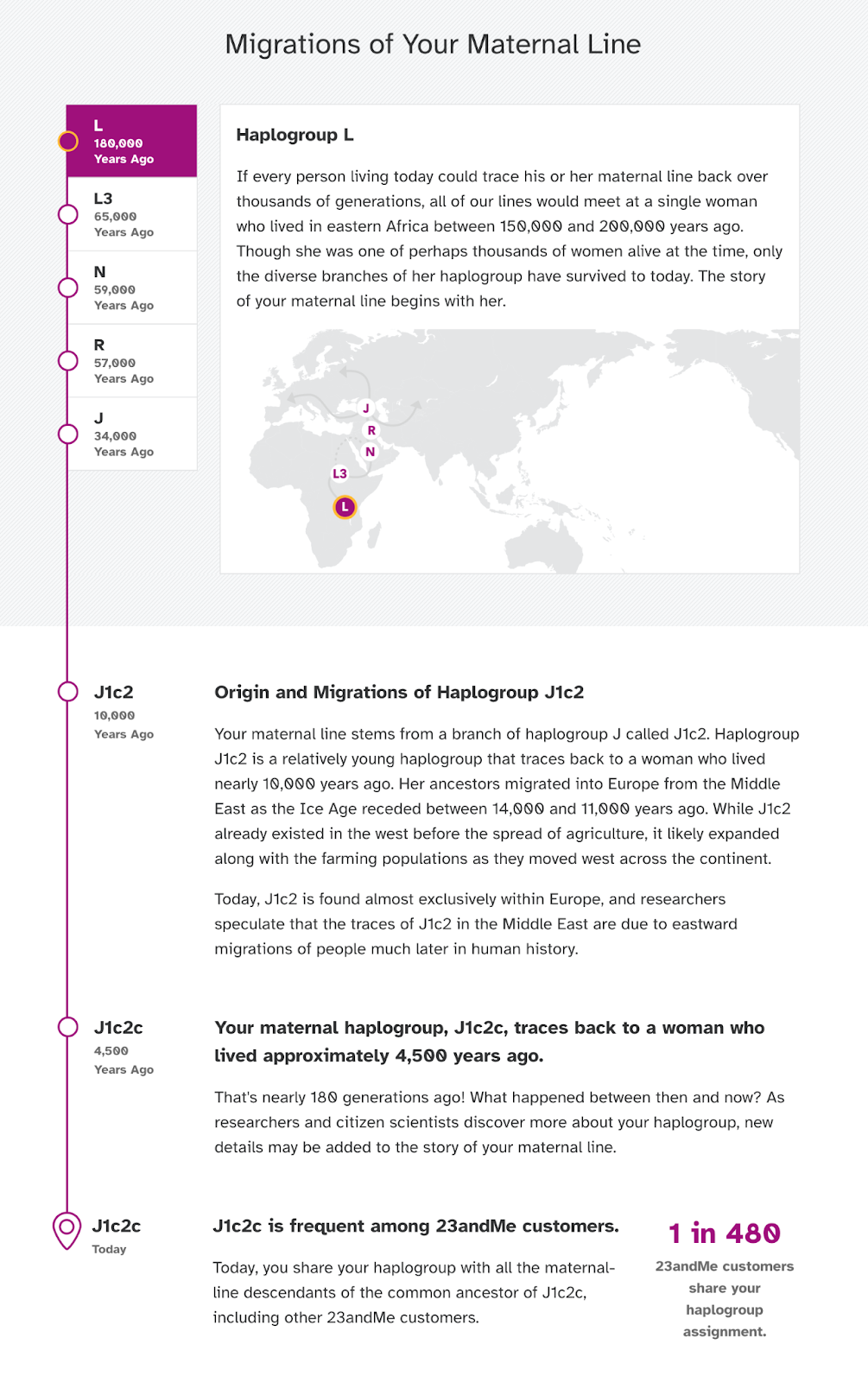
Source: 23andMe, personal profile of Mrs Vira Filatova
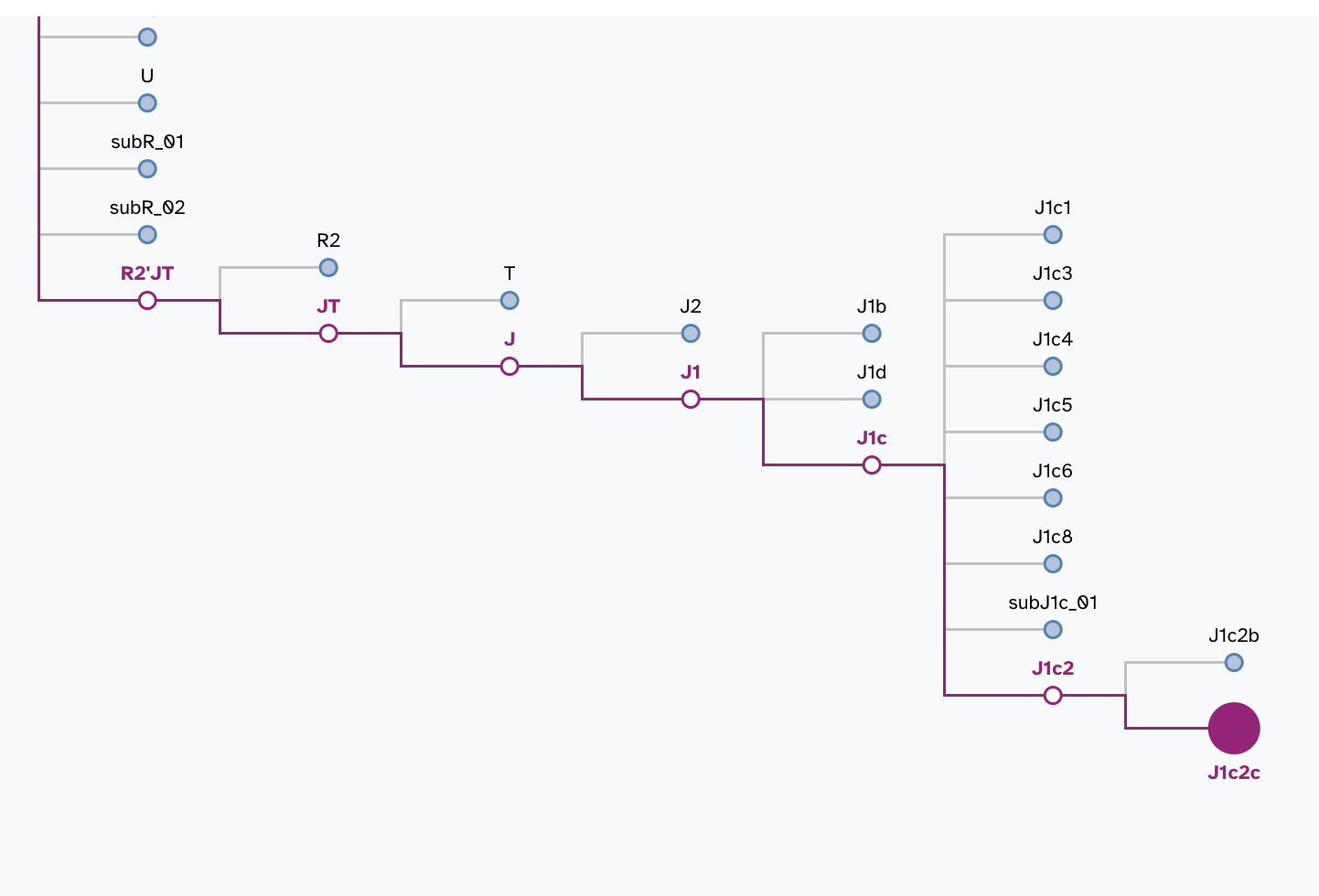
Source: 23andMe, personal profile of Mrs Vira Filatova
“In our “King Richard III and his mitochondrial DNA haplogroup J1c2c3” paper, the breakdown of J1c2c subclades is shown. Even though it has the same name, the haplogroup J1c2c is also a subclade of J1c2c as well as other subclades like J1c2c3. The j1c2c3 subclade has an estimated 500,000 people in the world while the J1c2c total group has 3,000,000” Source: https://www.historysoft.com/richard3/J1c2c3_points.pdf
.
According to this publication https://www.historysoft.com/richard3/J1c2c3_points.pdf there is 1 in 480 probability to be of this group. There are 3 million people in the world estimated to share this haplogroup. All these people (me included) share a common female ancestor with Richard III, but that would be someone living thousands of years ago.
When did our common ancestor live?
If I understand this https://www.yfull.com/mtree/J1c2c/ correctly then J1c2c has formed 8,600 years ago, also this article https://en.wikipedia.org/wiki/Haplogroup_J_(mtDNA) shows “between 8,900 and 17,100 years old” for J2a1a which sounds similar.”
| J2a1a | 12,986.1 ± 4,077.7 (Between 8,900 and 17,100 years old) |
Based on table here: https://en.wikipedia.org/wiki/Haplogroup_J_(mtDNA)
J1c2c traces back to a woman who lived approximately 4,500 years ago (nearly 180 generations).
Additional source – GenBank databank
For additional verification, I have used information from GenBank databank maintained by Ian Logan, source: http://www.ianlogan.co.uk/sequences_by_group/j1c2c_genbank_sequences.htm
‘GenBank’ is part of the ‘National Center for Biotechnology Information’ and holds over 60,000+ mtDNA sequences submitted by scientists and private individuals.

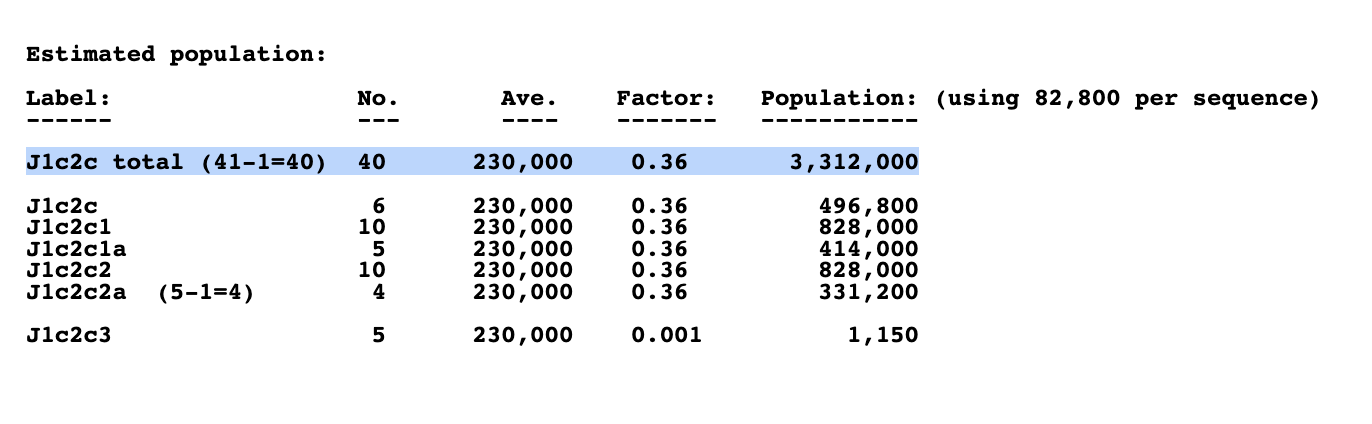
According to the data bank and the estimation by Ian Logan, there are 3,312,000 people in total who possess a J1c2c haplogroup. The total world population is around 8 billion, so
x/100 = 3,312,000/8,000,000,000
x = 0.04%
In other words, there is about 0.04% probability that any random person you meet has a J1c2c haplogroup and is a relative of King Richard III via their maternal haplogroup trait.
That doesn’t mean however they can’t be a relative of King Richard III via some other DNA factor, it’s just we only have an easy way to track mitochondrial DNA relatives this way and thus we focus on it in our research.
Conclusion
In other words, if you were to visit a corner shop it’s not likely you would stumble upon another maternal haplogroup relative of Richard III.
If you were to visit a major sports event however, with over a thousand people attending, there is a strong probability there will be someone like you in the crowd.
There are estimated 3 million people in the world who can claim they share the same maternal haplogroup with Richard III. The probability is about 1 in 480.
If you too possess J1c2c haplogroup that means both you and Richard III can trace your origins to the same woman who lived between 4,500 to 13,000 years ago, according to different estimations.
The European woman who lived 13,000 years ago
We have now clearly established that Mrs Filatova, along with 3 million other people in the world, share the same maternal ancestor with Richard III, and that this ancestor was a “European Woman” who lived around 13,000 years ago.
So that “European Woman” – any chance we could find out more information such as where did she live or what ancestry is she coming from?
Can modern science tell us where she lived or where she came from?
Note: this section, too, is citation heavy. Feel free to skip to Conclusions below.
“J1c is quite rare in the Middle East today, suggesting that hunter-gatherers of this lineage diffused into Europe during Neolithic times. Now, haplogroup J1c is the most commonly found subclade of haplogroup J in Europe, and one study found that it is the most frequent maternal lineage amongst Scandinavians.”
“Haplogroup J appeared when Scandinavia was transitioning to agriculture over 6 kya, with J1c being the most common lineage there today. Changes in the distribution of haplogroup J mtDNAs were likely driven by the expansion of farming from West Asia into Southern Europe, followed by a later expansion into Scandinavia, with other J subhaplogroups appearing among Scandinavian groups as early as the Viking Age.”
Source: “Phylogeographic history of mitochondrial haplogroup J in Scandinavia”, Am J Biol Anthropol. 2022 Nov 23;180(2):298–315. https://pmc.ncbi.nlm.nih.gov/articles/PMC10100211/
According to this, our haplogroup J1c has developed due to agricultural expansion initially from West Asia into Southern Europe and then into Scandinavia appearing there during the Viking Age.
“The expansion of Viking populations in the 10th and 11th centuries may have further shaped the distribution of haplogroup J in northern Europe. Women have been cited as important agents in the Viking expansions as settlers both inside and outside Scandinavian borders (Goodacre et al., 2005; Krzewińska et al., 2015). Based on archaeological evidence, the Vikings often incorporated non‐Scandinavian individuals into their populations (Krzewińska, 2014), and established several satellite communities outside of Scandinavia that persisted until the end of the Viking Age in the 11th century CE”
“Subhaplogroup J1c was the most frequent maternal lineage among modern Scandinavians in our study. Several modern Scandinavian sequences such as J1c7 (8.8 kya [95% CI: 5.9–14.6]) occurred on the same subbranch with those identified in Russia, Ukraine, Spain, Italy, Greece, and the British Isles. The youngest branches of the subhaplogroup J1 phylogenetic tree are J1c3g (6.4 kya [95% CI: 4.4–9.5]) and J1c3c (4.6 kya [95% CI: 2.7–7.3]) and are shared by populations from Denmark and Germany. Subhaplogroups J1c4 (5.1 kya [95% CI: 3.5–8.3]) and J1c5 (8.1 kya [95% CI: 5.3–12.7]) are also shared between Italians and Danes. Collectively, these findings point to the Mediterranean, Germany, and British Isles as potential sources for these types of haplogroup J mtDNAs in Scandinavia.”
“The earliest evidence for haplogroup J in Scandinavia is a subhaplogroup of J1c found in a Eurasian Bronze Age/Scandinavian Neolithic Age individual from Sweden, although sequences deriving from older branches of haplogroup J are also present among modern‐day Scandinavian and Viking Age individuals. Based on the divergence time estimates, subhaplogroup J1c likely appeared when Scandinavia was transitioning to agriculture and animal husbandry. Given that sequences from subhaplogroups J2a, J2b, and J1b, and J1d are present in both modern‐day Scandinavian populations and Viking Age individuals, the difference in subhaplogroup J distributions likely reflects the incorporation of non‐Norse individuals during Viking Age expansions, who were gradually assimilated into Scandinavian populations. However, we cannot exclude other sources of these mtDNAs.”
“Our phylogenetic analysis provides a detailed view of haplogroup J phylogeography. It supports the origin of this major maternal lineage in Western Asia, and its dispersal into Europe and Scandinavia through the transition to agriculture over thousands of years. Ancient DNA evidence suggests that the transition from hunting‐foraging to farming started in southern Scandinavia, with diverse mtDNA haplogroups gradually replacing the predominant haplogroup U mtDNAs (Melchior et al., 2010). Archaeological evidence for tools and burial sites further supports the idea that agricultural practices were brought to Scandinavia with northward migrating European farmers, and that indigenous hunter‐gatherers were gradually assimilated into the farming cultures (Fischer, 2002). Radiocarbon analysis of 24 regions with known European Neolithic populations and increased population growth rates confirmed that agriculture dates for eastern and southern European regions dated to ~7500 to 7200 cal BP while in northwest Europe they were around 6000 cal BP (Downey et al., 2014). An increase in population growth rates is commonly observed in Neolithic populations due to increased access to sustenance and resources (Bocquet‐Appel & Bar‐Yosef, 2008), and this may have led to expanded frequencies of haplogroup J mtDNAs in them.“
“Haplogroup J originated approximately 42.6 kya (95% CI: 30.0–64.7), with several of its earliest branches being found within the Arabian Peninsula and Northern Africa. J1b was found most frequently in the Near East and Arabian Peninsula, while J1c occurred most frequently in Europe. Based on phylogenetic dating, subhaplogroup J1c has its early roots in the Mediterranean and Western Balkans. Otherwise, the majority of the branches found in Scandinavia are younger than those seen elsewhere, indicating that haplogroup J dispersed relatively recently into Northern Europe, most plausibly with Neolithic farmers.”
(same source)
Conclusions
Based on the information we discovered, there was a movement of population from West Asia to Scandinavia, across Southern Europe, with westward trend (West Asia to Europe) being caused by population pressure (farming invented), and eastward trend (Scandinavia to Europe) due to Viking expeditions in Europe. Our haplogroup J1c, according to research, has roots in the Mediterranean and Western Balkans.
We also know that vikings have frequented the territory of modern Ukraine. The Borisphen (modern Dnipro) river, going through the capital city of Kyiv, has been famously a part of a trade route between Vikings and Greeks). It is also well known that the kings of Kyivan Rus were often of Scandinavian origin (so called Varangians, mostly from present-day Sweden). This creates multiple probable ways how my J1c maternal ancestors could have ended up in Ukraine including earlier migration from Mediterranean and Balkans, or travelling along with Scandinavian warriors, traders or settlers along the Dnipro trade route between 8th-11th centuries. The Dnieper (Dnipro), Dniester and Volga were the major trade routes at the time, see illustration below.
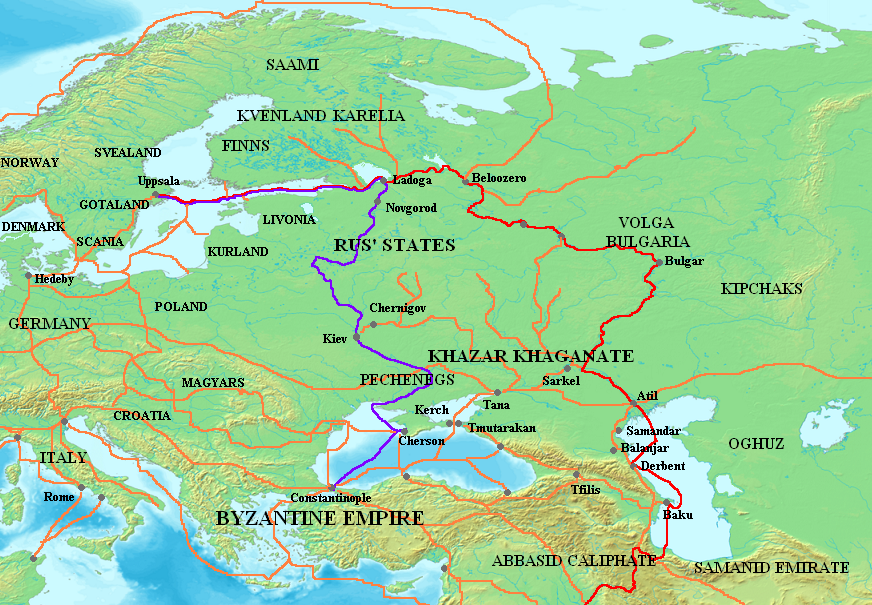
Map showing the major Varangian trade routes: the Volga trade route (in red) and the Dnieper and Dniester routes (in purple). Other trade routes of the 8th–11th centuries shown in orange. Source: https://en.wikipedia.org/wiki/Varangians
That is probably as deep as we can go using the top-down approach i.e. tracing where haplogroup J1c originated and how it ended up in the genes of my mother’s maternal ancestors in Ukraine. We should look into alternative options if we are to discover more information.
Tracing the maternal ancestors of Richard III
Now, is there a way to trace things using a bottom-up approach? I.e. using a more modern-day owner of J1c haplogroup genes who has its genealogy properly documented across generations. That would allow us to trace at least a few centuries back and understand whether we can discover any evidence or interesting facts from the ‘bottom end’. Such facts would be any history of migration into British Isles from another European country and so on. This is where a royalty is indispensable and this is where I thought our distant relative Richard III will be of assistance 🙂
Tracing the maternal thread starting from Richard III
Let’s trace the maternal ancestors of Richard III as deep as we can, starting from his mother Cecily Neville:
- Richard III’s (02.10.1452 Northamptonshire, UK – 22.08.1486, Bosworth Field, UK)
- Cecily Neville (03.05.1415 Durnham, UK – 31.05.1495, Berkhamsted, UK)
- Joan Beaufort (1377 – 13.11.1440, Howden, Yorkshire, UK)
- Katherine Swynford (de Roet) (1349 – 10.05.1403, Lincoln, UK)
- Unknown (?)
Now, the mother of Katherine Swynford is not known for sure. Wikipedia does not specify anything for “Mother” there meaning that historians are not in agreement on any conclusive evidence here:
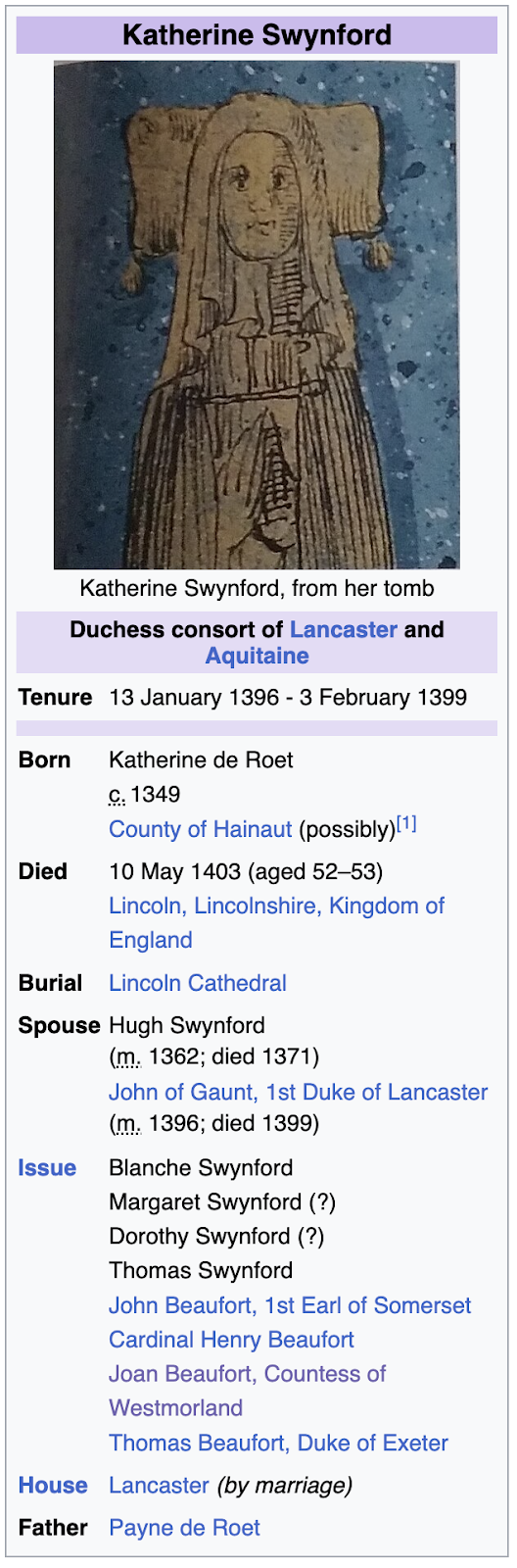
Source: https://en.wikipedia.org/wiki/Katherine_Swynford
It is only known that her father was Payne de Roet, a knight from Hainaut (Holland). They have come to England from the lands of modern Belgium.
Finding the mother of Katherine Swynford (de Roet)
While Wikipedia and other peer reviewed sources tell us that the mother of Katherine Swynford is unknown, after some research I was able to establish two major versions.
“There is no reliable information regarding Katherine’s mother. According to some reports, Paon de Roet was married twice. It has been suggested that one of his wives was a relative of Queen Philippa, but there is no documentary evidence for this version.”
Source: https://en.wikipedia.org/wiki/Katherine_Swynford
“Alison Weir believes that two children were born from Paon’s first wife: the eldest daughter, Isabel (also called Elizabeth) —who later became in the Noble canoness of the very influential Saint Waltrude Collegiate Church in Mons (which, according to Weir, is evidence of Paon’s close connection with the ruling family of Hainaut)—, and a son, Walter. The mother of Katherine and another daughter, Philippa[9] (who married the famous English poet Geoffrey Chaucer), was, according to Weir, Paon’s second wife.”
Source: https://en.wikipedia.org/wiki/Katherine_Swynford
Version 1 – Catherine of Avesnes
“On some sites, Catherine of Avesnes, sister of William I, Count of Hainaut, Queen Philippa’s father, is listed as the mother of Katherine Swynford. However, this version has two problems. The first is due to the fact that the name Catherine is not found among the names of the known sisters of Count William I. The second problem is chronological: William I’s father, John II, Count of Hainaut and Holland, died in 1304, so Catherine of Avesnes, born before 1304, could not be the mother of Katherine Swynford, who was born around 1350.
(same source)
Indeed, certain websites, for example, MyHeritage (http://www.myheritage.com/research/collection-40001/familysearch-family-tree?s=270781241&itemId=916920108&action=showRecord&indId=individual-270781241-1501931) and McKay / Stevens Genealogy pages: (https://mckaystevens.us/genealogy/getperson.php?personID=I2865&tree=1) clearly postulate that Catherine D’Avesnes, born in 1315 in Picardie, France, has given birth to Philippa de Roët in 1346 in Hainaut (modern Belgium) and to Katherine de Roët (Swynford) on 25th November 1350 in Picardy, Hainault (modern France).
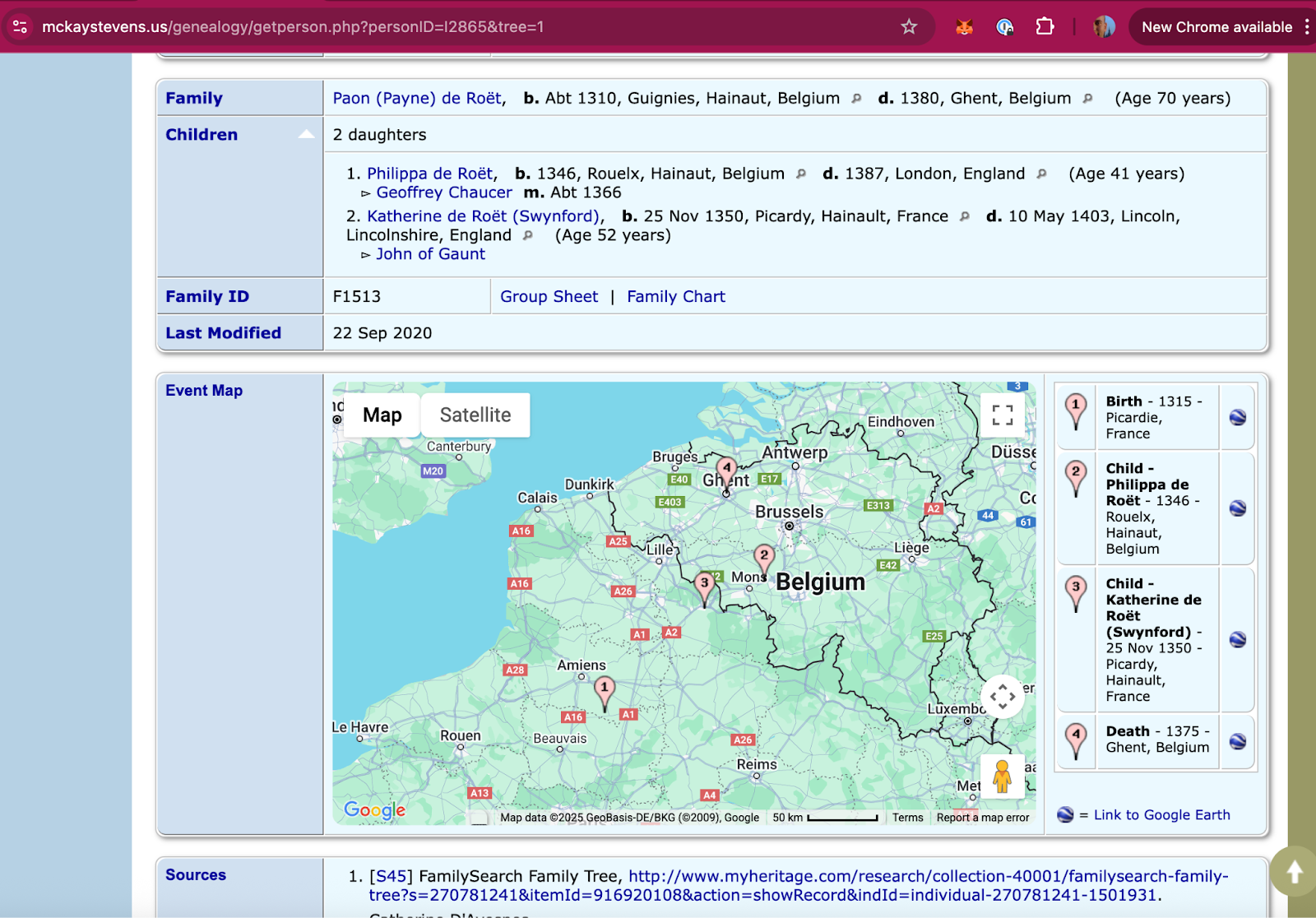
Source: McKay/Stevens Genealogy Pages
“Katherine’s year of birth is not documented. In 1631, John Weever claimed that she was the eldest of Paon de Roet’s daughters, but that would make her at least 28 years old at the time of her first marriage, which is much older than the typical age girls married. Alison Weir believes that Weever did not know about the existence of Elizabeth de Roet and the other two daughters. The author of the article of Katherine Swynford in the Oxford Dictionary of National Biography believes that she was born around 1350, with which Weir agrees. They calculate the possible year of her birth based on the fact that Katherine married for the first time around 1362/1363 and gave birth to her first child around 1363/1364, and the canonical age at which a girl could marry and have marital relations with her husband, in that time was 12 years old. Weir further clarifies that Katherine was most likely born in 1349. She was probably named after St. Catherine of Alexandria whose cult at that time was gaining strength.”
Katherine’s birthplace is sometimes called Picardy, with which Alison Weir does not agree. This error, in her opinion, arises from the fact that some historians confuse Philippa de Roet, Katherine’s sister, who was in the service of Queen Philippa, with certain Philippa Picard, but these are completely different personalities. Katherine was probably born in the County of Hainaut, as indicated by the account of the chronicler Jean Froissart, who calls her a “resident” from there, and the chronicler Henry Knighton, who calls her “a certain foreigner”. It is possible that Katherine’s birthplace was her father’s possessions, located near Mons.
(same source)
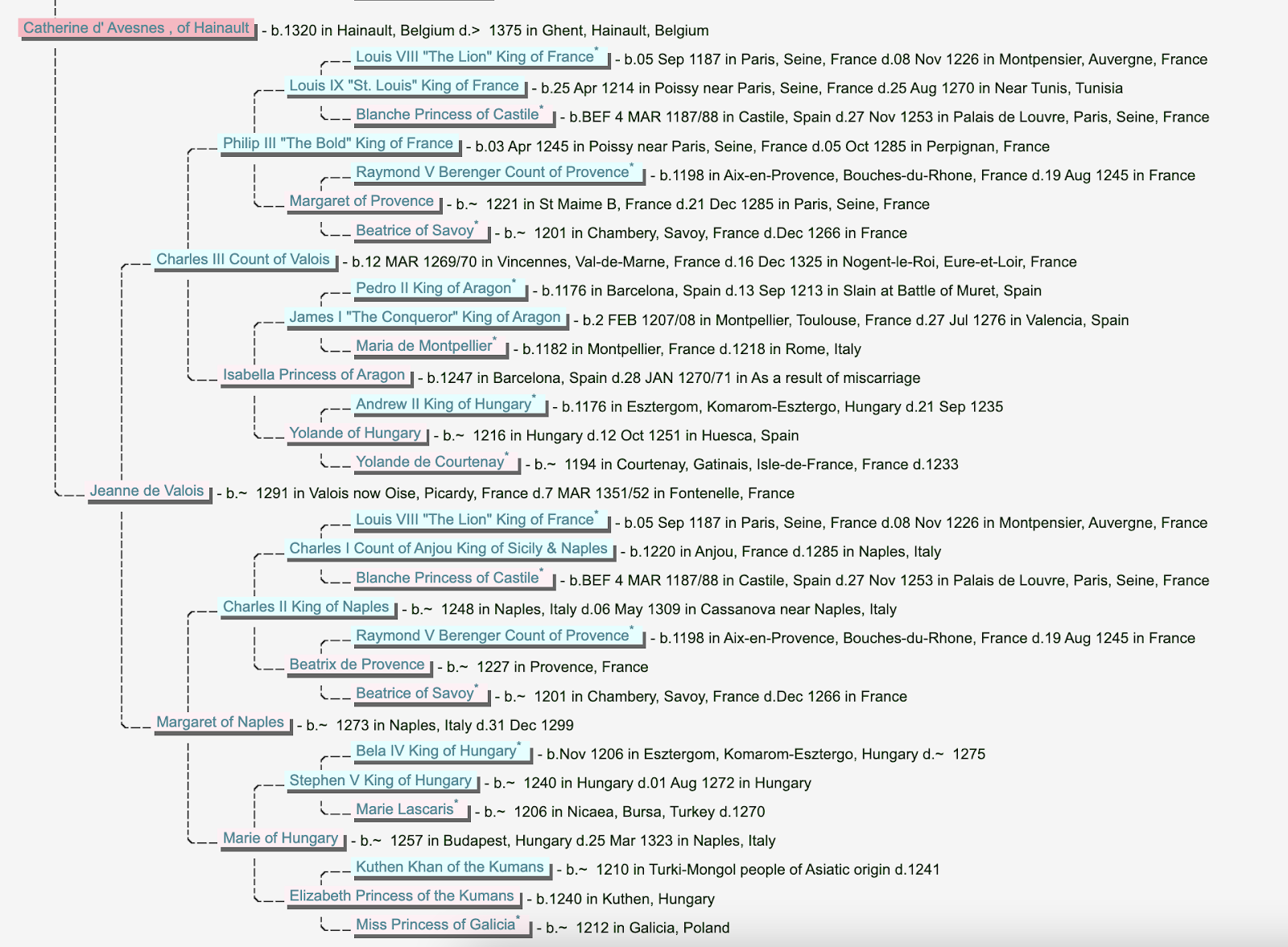
Source: https://familytrees.genopro.com/Azrael/2582920/Avesnes-CatherineD-I6455.htm
Version 2: A daughter of Count William I
Now, this is interesting:
“There is another version, according to which Katherine Swynford’s mother was not a sister, but the daughter of Count William I and, thus, the sister of Queen Philippa. However, in such a case, Katherine Swynford would have been John of Gaunt’s first cousin, so chroniclers would have to note this fact when describing their love affair. In addition, their marriage would require special papal permission, but John of Gaunt does not mention such an obstacle. In addition, among the daughters of Count William I, a daughter named Catherine is also not mentioned.”
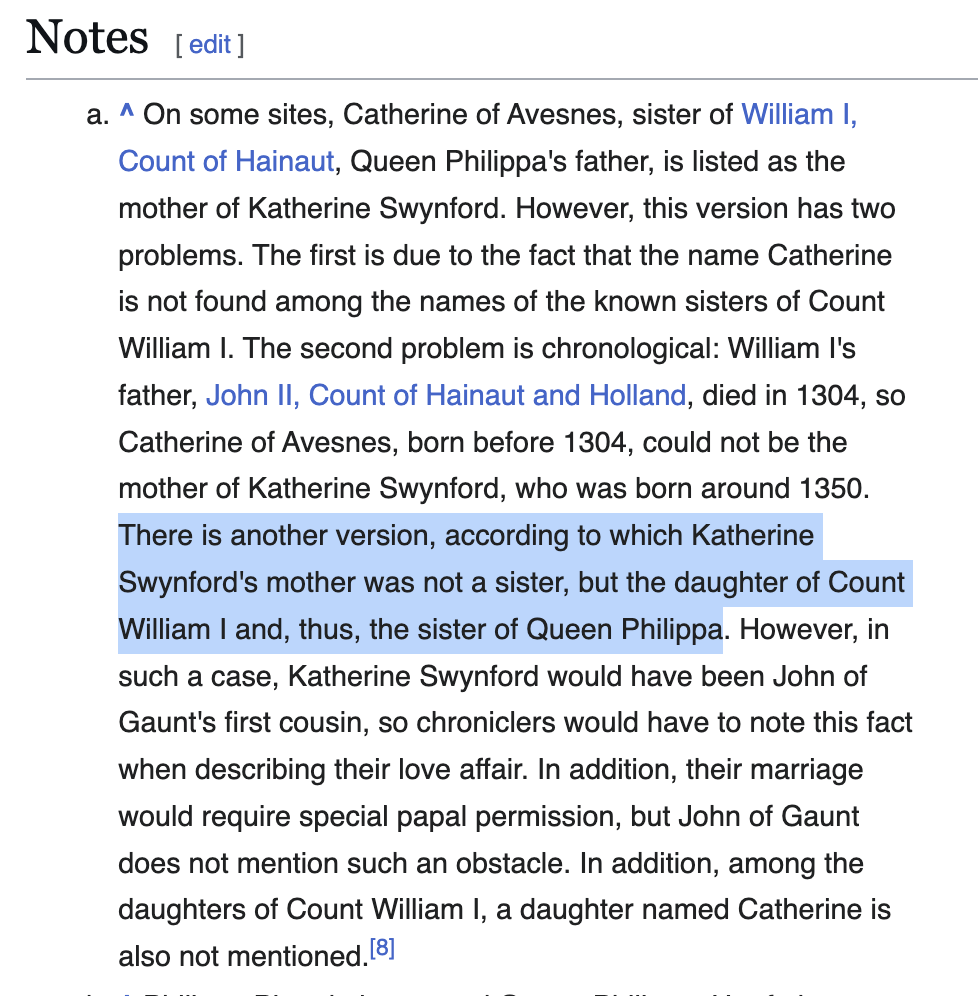
Source: https://en.wikipedia.org/wiki/Katherine_Swynford; via Weir, Alison (2007). Katherine Swynford: The story of John of Gaunt and his Scandalous Duchess. London: Vintage Books. ISBN 978-0-7126-4197-5.
In case Version 2 is correct, the grandmother of Katherine Swynford (de Roet) was Joan of Valois.
Regarding the possible mother it is unclear, but if we exclude Queen Philippa then we have the following known options:
William II, Count of Hainaut (1307–1345)John (died 1316)- Margaret II of Avesnes, Holy Roman Empress (1311–1356), Countess of Hainaut and Holland, married Louis IV, Holy Roman Emperor[7]
Philippa of Hainault, Queen of England (24 June 1314 – 1369), married king Edward III of EnglandAgnes (died 1327, age 7)- Joanna of Hainaut, Duchess of Jülich (1315–1374), married William V, Duke of Jülich.
- Isabella of Hainaut (1323–1361), married Robert of Namur, the son of John I, Count of Namur. There was no issue.
Louis (1325–1328)
For the purpose of my research I find Version 2 here more plausible. The problems with Version 1 are of a blocking nature, while the lack of expected historical records around Version 2 could be simply explained by the delicacy of the matter.
Our assumption here therefore is that Joanna of Hainaut was Kathernie Swynford’s mother:
Joanna of Hainault (c. 1312–1374) was a Duchess of Jülich by marriage to William V, Duke of Jülich. She was the third daughter[1][2] of William I, “The Good” Count of Hainaut, and Joan of Valois.[3] She was a younger sister of Philippa of Hainault, Queen of England, and Margaret II, Countess of Hainault
Source: https://en.wikipedia.org/wiki/Joanna_of_Hainaut
Also, from our perspective of mtDNA tracing, as long as we have certain confidence in grandmother, we can skip the mother.
This allows us to return to tracing the maternal ancestor tree of Richard III.
- Joan of Valois. https://en.wikipedia.org/wiki/Joan_of_Valois,_Countess_of_Hainaut whose mother
- Margaret of Anjou. https://en.wikipedia.org/wiki/Margaret,_Countess_of_Anjou and whose mother is
- Mary of Hungary, Queen of Naples: https://en.wikipedia.org/wiki/Mary_of_Hungary,_Queen_of_Naples.
- Her mother, in turn, was Elizabeth the Cuman: https://en.wikipedia.org/wiki/Elizabeth_the_Cuman (1244–1290).

Table: Version 2: tracing Richard III’s maternal ancestry to Elizabeth the Cuman
So we have discovered something interesting here. The maternal lineage of Richard III has reached, via France and Belgium, to Hungary and then to certain people of Cuman (Kumans). Who are those people?
The Cuman people and Hungary escape
Now, Cuman-Kipchak Confederation has occupied wide areas across southern parts of modern Ukraine and Russia also spanning into Moldova and Romania. It is also stated that Cumans and/or Kipchaks have settled in the “historic region of Kunság in Hungary, and the former Roman Catholic Diocese of Cumania (in Romania and Hungary)”.
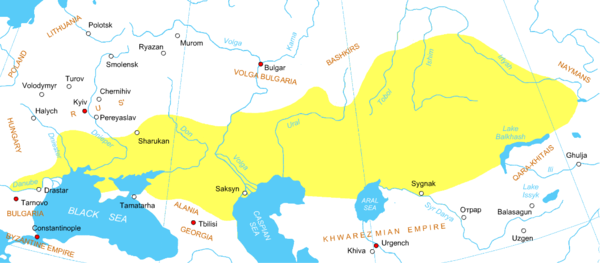
Cumania (Desth-i Qipchaq) c. 1200
Source: https://en.wikipedia.org/wiki/Cumania
The Cumans and Kyiv Rus’
For Ukrainian people those Cumans have been well known as “Polovtsy” (Polovtsians) as they were the migrating tribes constantly harassing the settlements of Kyivan Rus’. The kings of Kyiv (Kiev) and other prominent cities of Kyivan Rus’ would organize military campaigns, often successful, to repel Polovstians.
The demise of Kyivan Rus’ started in the 11th century and lasted until the 14th century. It is believed that the major factor in the demise could have been the constant attacks from Polovtsians and the organised conquest by the Golden Horde of Mongol-Tatar.
Side note: Mongols are are also being referred by the same name of “Comania” by Armenian chronicler Hethum (Hayton) of Korykos: https://en.wikipedia.org/wiki/Cumania#cite_note-Spinei-5.
This, I believe, is not entirely accurate because those were different peoples, at least politically. Moverover, Cumans or Polovtsy have joined forces with Rus’ people to put up a fight against Genghis Khan in 1223 at the Battle of Kalka. Despite Cumans being a nomadic tribe of Turkic origin, apparently they found it better to unite with Kyivan Rus’ people, their former enemy, in the face of an external existential threat having emerged:
“This Pontic Cumania, (and the rest of the Cumanias to the east), ended its existence in the middle of the 13th century, with the Mongol invasion of Europe. In 1223, Genghis Khan defeated the Cumans and their Rus’ allies at the Battle of Kalka (in modern Ukraine)”
What may be also relevant to us is that Polovtsy / Cumans have soon ceased to exist as a confederacy leaving the lands they have formerly controlled, due to the abovementioned Mongol invasion:
“and the final blow came in 1241, when the Cuman confederacy ceased to exist as a political entity, with the remaining Cuman tribes being dispersed, either becoming subjects of the Mongol conquerors as part of what was to be known as the Golden Horde, or fleeing to the west, to the Byzantine Empire, the Bulgarian Empire, and the Kingdom of Hungary.”.
(source: Wikipedia https://en.wikipedia.org/wiki/Cumania)
The latter sentence is of most interest to us as this helps to explain how Elizabeth the Cuman has ended up becoming a Queen of Hungary and, possibly, a maternal ancestor of Richard III. Indeed, it turns out that her father*, Khan Köten has led Cumans “and a number of other clans” in invading the Kingdom of Hungary in 1238. This decision was a direct result of the Kalka river defeat and Cumans themselves having to flee the advancing hordes of the Mongol Empire.
*Note that the sources differ whether the reference of “Seyhan” in the charter of Elizabeth’s father-in-law, Hungarian king Bela IV, refers specifically to Khan Köten or whether it was a reference to another chieftain among the Cumans.
Köten or Kotyan was a son of another Cuman chieftain, a reformer of sorts, as he passed rulership to his son instead of it going to the most senior tribal leader as was the Cuman tribal custom at the time. No one else but Köten himself has apparently forged the alliance with the Kievan Rus princes against the Mongol Tatars:
“He gave “numerous presents: horses, camels, buffaloes and mistresses. And he presented these gifts to them, and said the following, ‘Today the Mongols took away our land and tomorrow they will come and take away yours’.” The Cumans were ignored for almost a year, however, as the Rus’ had suffered from their raids for decades. The Cuman–Kipchak confederation under Köten and a Rus army of 80,000 men under his son-in-law Mstislav the Bold fought a battle at the Kalka River (Kalchyk, near Mariupol) against a Mongol contingent commanded by Jebe and Sübötäi. The Rus-Cuman army was routed and had to retreat on 31 May 1223. Köten narrowly escaped from the battlefield, while other Cuman chieftains were killed.[4] Köten was deposed from power in that year, but he remained leader of the Terteroba clan.”
Elizabeth the Cuman, daughter of a Polovtsi chieftain
In 1244, Elizabeth the Cuman was born in Hungary. She is of special interest to us as, if version with Joan of Valois is true, this woman originating from the steppes and territories nowadays called Ukraine, was a maternal ancestor of Richard III and, if confirmed, a bearer of haplogroup J1c2c.
According to all we know, Elizabeth the Cuman was a daughter of Khan Köten himself or another Cuman chieftain. The records tell us that Köten and his retinue were massacred on 17 March 1241 by a Hungarian mob led by local barons mistrusting the Cumans. This likely has been triggered by the earlier events: (1) Mongols broke through the Verecke Pass on 12th March 1241; (2) Part of the seized Mongol prisoners included Cumans from the Eurasian Steppes who had been forced to join the Mongols.
Back to Elizabeth, there are multiple possibilities here where either the chronology in the records is incorrect and she indeed was a daughter of Khan Köten born before the massacre; she could also have been a daughter of the later Cuman leader who took over after Köten’s death. Cumans are known to have departured towards Balkans (Bulgaria), pillaging and killing on their way, following the misunderstanding in 1241. In this way Hungary and Béla IV in particular have lost important allies who could have helped against Mongols. Later on, king Béla IV invited the Cumans to return and settle again along the river Tisza. To seal this, he arranged his son Stephen to engage with Elizabeth.
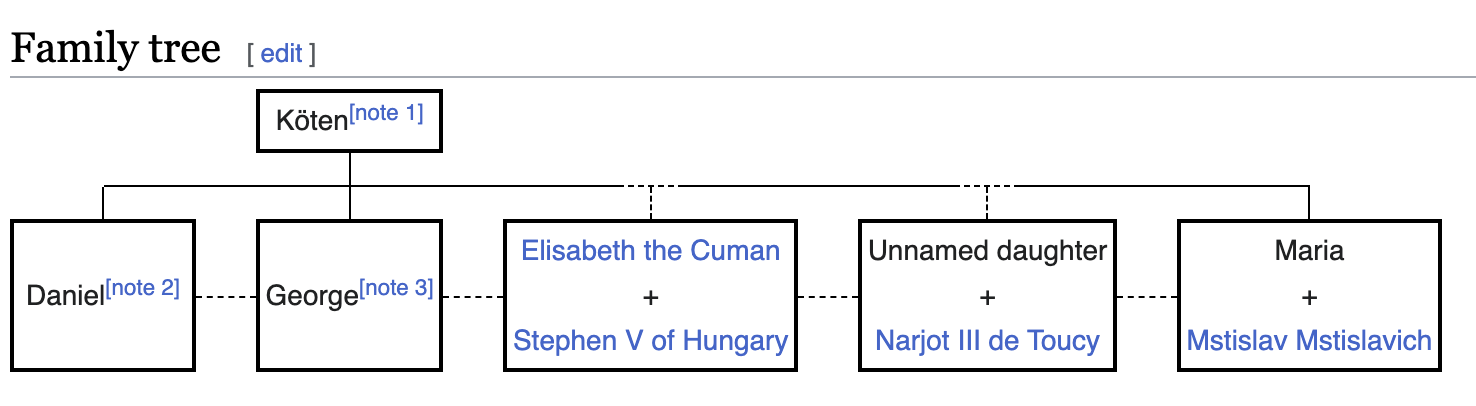
Source: https://en.wikipedia.org/wiki/K%C3%B6ten
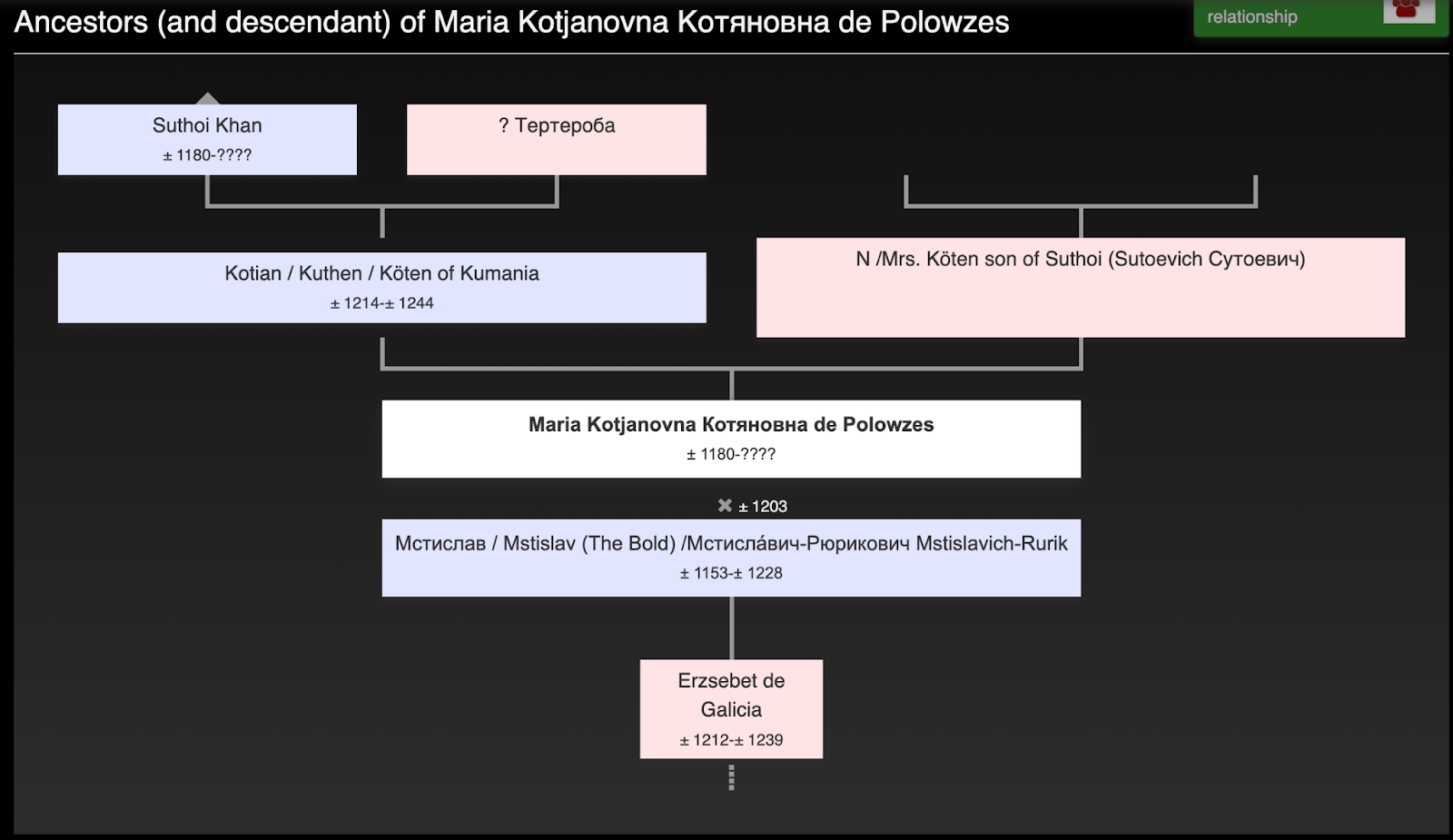
Source: https://www.genealogieonline.nl/en/stamboom-homs/I6000000003827512244.php
The contradictory (Polish?) records
We should note that at the same time there is certain contradictory or rather confusing evidence at some websites mentioning the “Prince of Galicia” and “Princess of Galicia”:
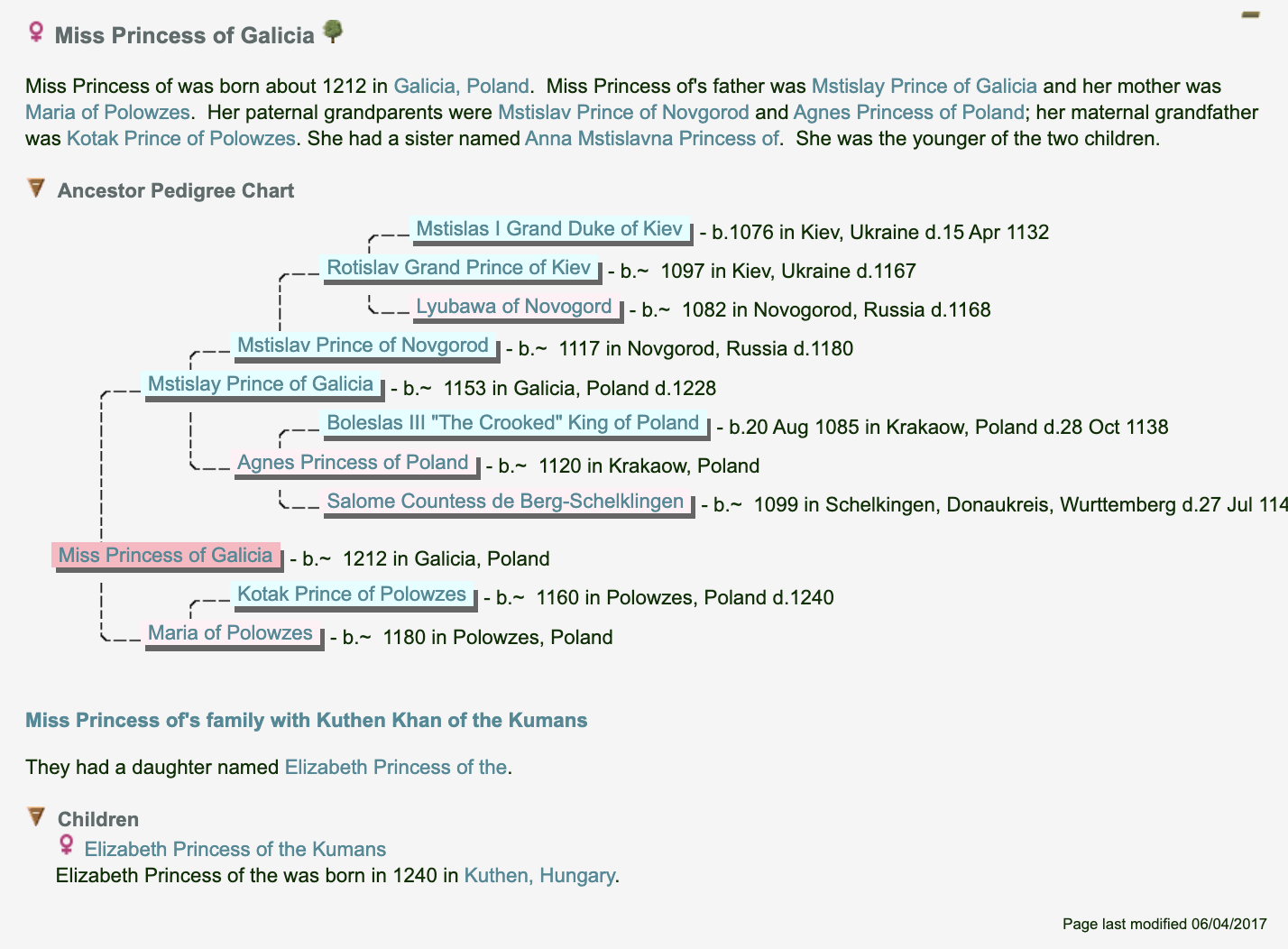
Source: https://familytrees.genopro.com/Azrael/2582920/Galicia-MissPrincessOf-I6562.htm
—
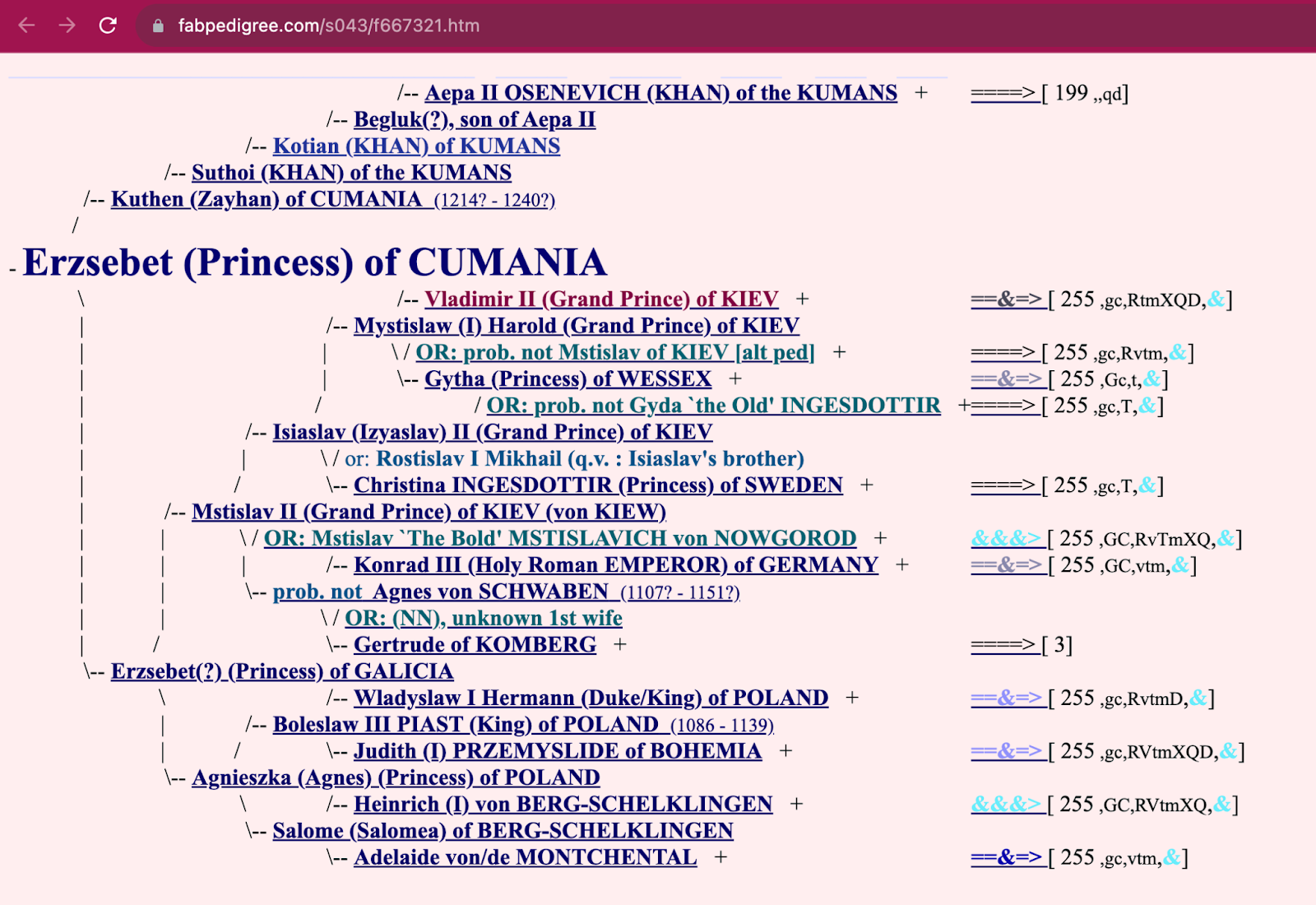
Source: https://fabpedigree.com/s043/f667321.html
According to the same source,
“Personal data Maria Kotjanovna Котяновна de Polowzes. She was born about 1180 in Polowzes, Poland. She died in Novgorod, Russia. A child of Kotian / Kuthen / Köten of Kumania and N /Mrs. Köten son of Suthoi (Sutoevich Сутоевич)”
however the location “Polowzes, Poland” is likely fictitious and simply refers to the family being of the Polovets origin as nicely stated by the author of an article here:
“the location of “Polowzes, Poland” is a cipher. “Polowzes” would appear to be a Polish rendition of “Polovtsi”, an alternative name for the Cumans frequently used by the Kievan Rus’. The daughter of “Kotak of Polowzes”, Maria Kotjanovna (i.e. daughter of Kotja / Kotak) of Novgorod, is said to have been born in “Polowzes, Poland” in 1180. Inasmuch as western Ukrainia was a part of greater Poland in later centuries, “Polowzes, Poland” would appear to be an ex post facto reference to the steppes of western Ukrainia rather than a specific urban settlement.”
“Kuthen, or Zayhan, a prince of the Cuman tribe, which had been pushed into Hungary by the invasions of Ghinghis-Khan.”
Source: https://math.clarku.edu/~djoyce/gen/oldfolks/rr03/rr03_359.html
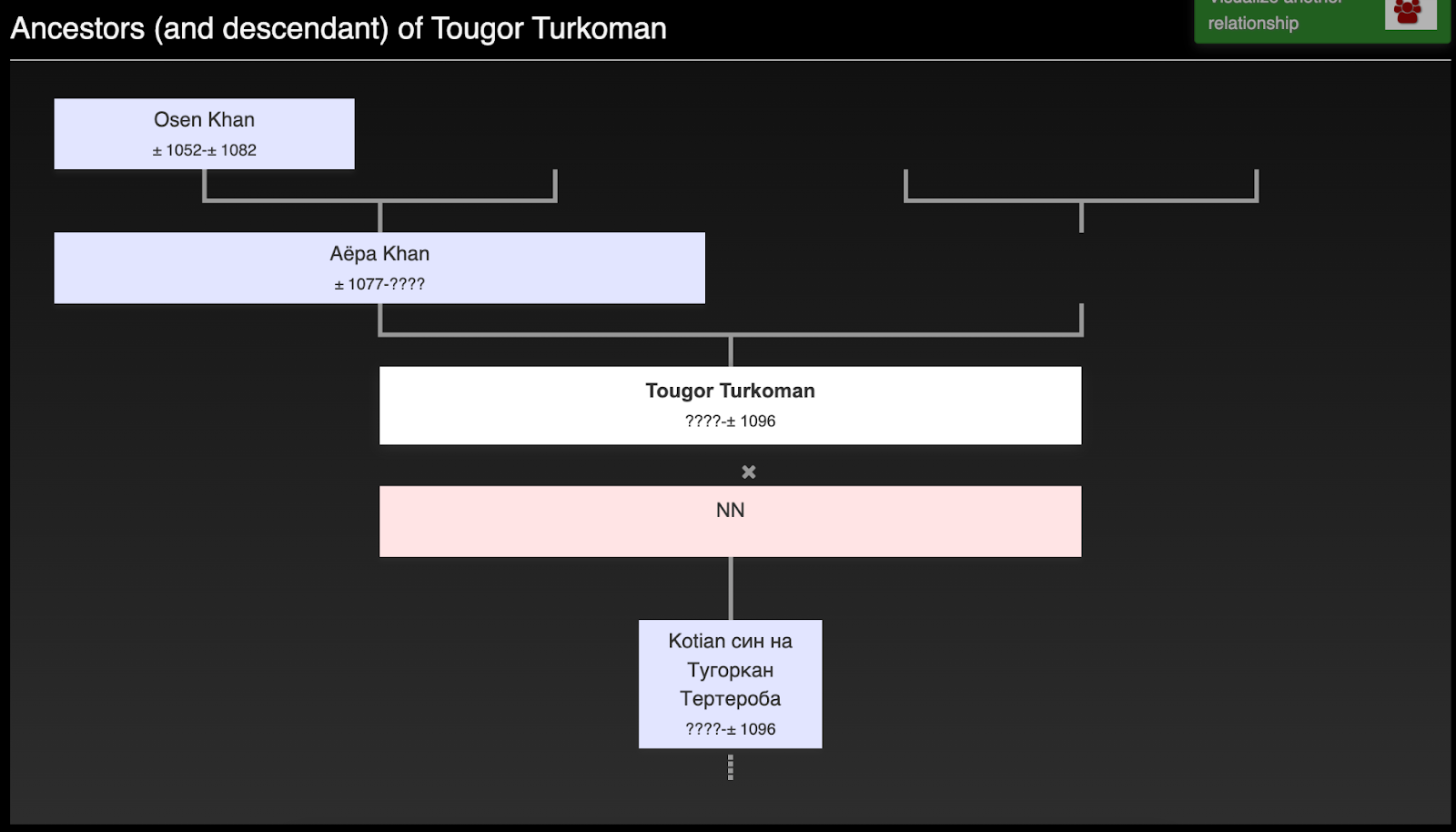
Source: https://www.genealogieonline.nl/en/stamboom-homs/I6000000001354340977.php
The Terteroby dynasty evidence
This piece on the Terteroba dynasty may seem tangential, but some of the information here is complimentary to our research so we provide it here in full. Highlighted with colour are the parts which are directly relevant. The source for this piece is: https://www.geni.com/people/Maria-of-Polowzes/6000000003827512244. The geni.com portal does not provide the name of the article author unfortunately. The extract we cite here is provided in Bulgarian originally and we provide and English translation here by Google Translate:
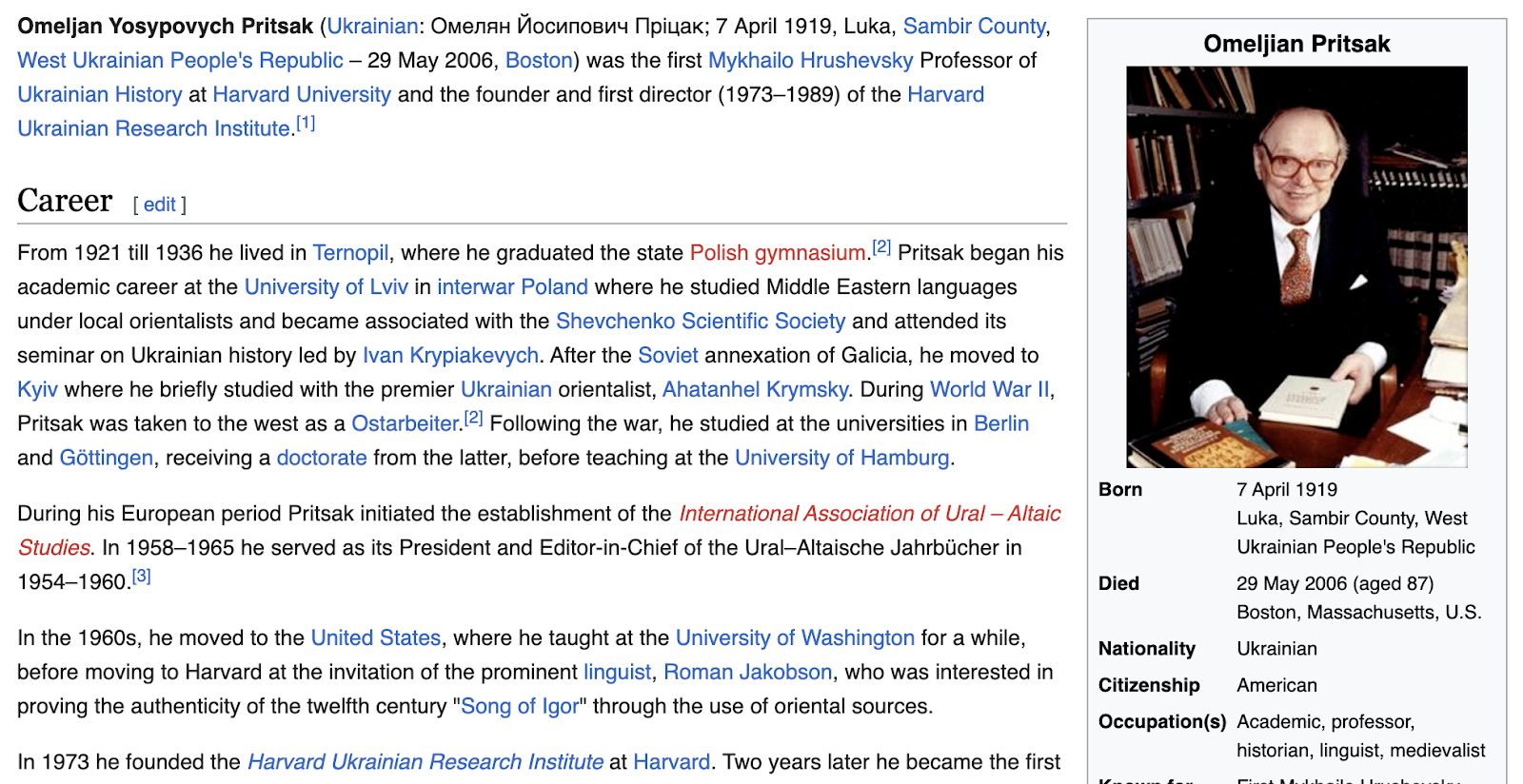
“In historiography, the fact that one of the Bulgarian medieval dynasties – that of Terterovtsi, played a key role not only in Bulgarian history is little known. Only recently have a number of publications appeared, and above all, the studies of the great American medievalist of Ukrainian origin, Omelyan Prytsak,..”
I can’t help but interrupt here with a reference to the profile of Omeljan Pritsak, please review it on Wikipedia if interested: https://en.wikipedia.org/wiki/Omeljan_Pritsak – I for one was excited to find out about this author.
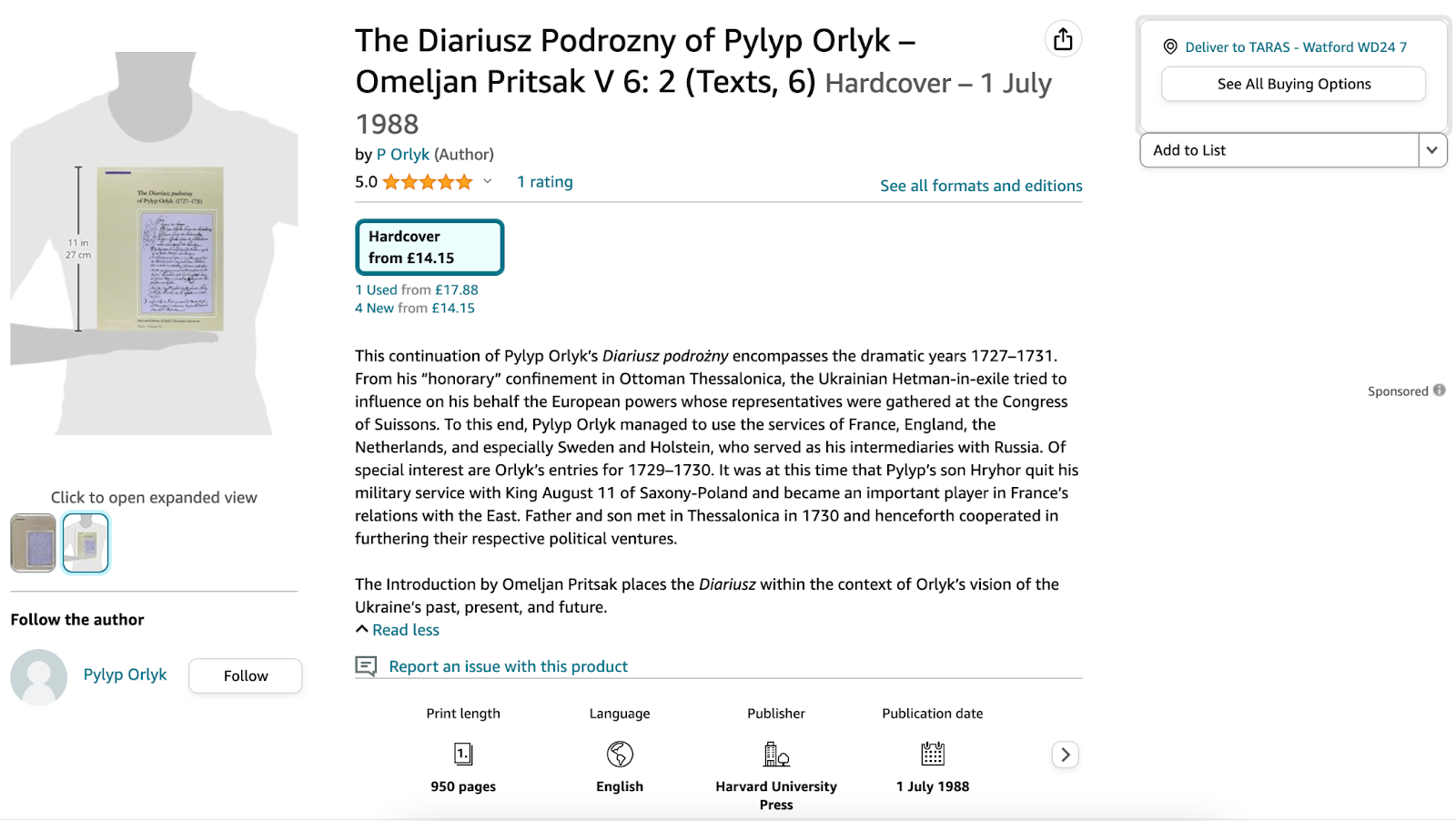
I was equally excited to be able to find at least one book by Omeljan Pritsak available on Amazon, and what book at that – the travel diary of Pylyp Orlyk, one of the most famous Ukrainian cossack hetmans:
“..have been illuminated, through which part of the pre-Bulgarian period of the family can be reconstructed. It became clear that probably one of the first Cuman princes – Sokal and Bolush, who led their people’s first campaigns against the Russian principalities – belonged to the Terter or Terteroba dynasty (“oba” in Cuman means family). At the end of the 11th century, Terteroba was one of the two supreme Cuman dynasties, and later, although it lost some of its power, it remained the highest rank among the Cumans along the Don River. Before that, however, Prince Tugorkan (Terteroba ?) became especially famous, who led a number of campaigns against Byzantium and became one of the most notable Cuman rulers in general.”
“In the 13th century, Terteroba regained its position, thanks to princes Kotyan and Somogur, sons of one Suto Terteroba. Prince Kotyan Sutoevich Terteroba was the last great Cuman ruler. As such, he married his daughter to the Russian prince Mstislav (TF note: “Russian” here obviously means of Kyivan Rus’ origin). Later, however, the Tatar invasion forced Kotian to flee at the head of part of his people to Hungary. There he was received by King István V, who even took his daughter Elisabeth as his wife. From this marriage was born the Hungarian king Ladislaus IV, who remained known by the nickname Kun (Cumanin). Soon after his arrival, however, Prince Kotian was murdered by the Hungarian aristocrats. This caused his descendants to leave the kingdom and move to Bulgaria and founded the dynasty that gave a number of rulers to the Kingdom of Tarnovo (Georgi I Terter, Teodor Svetoslav, George II Terter and probably Michael III and Ivan Stefan), to Vidin (Shishman, Michael ( ІІІ) and Belaur), Kran (Aldimir) and Karvun principality (Balik, Dobrotitsa and Ivanko).”
The name of that relative of Prince Kotyan (his son or nephew) who brought the family to Bulgaria is not known. However, the probable tombstone inscription of King George I’s brother Terter Aldimir (“Aldimir, son of voivode Vitomir”) indicates that his name may have been Vitomir. In any case, his sons Georgi and Aldimir will play a key role in the history of Bulgaria at the end of the 13th century.
In our research, however, we are more interested in the female side of things as we are tracking the maternal haplogroup through ages and generations. Unfortunately, not much is known in regards to the mother of Elizabeth the Cuman, similarly we can’t say for sure if she was a wife of Köten or another Cuman chieftain.
It is known that in order to settle in Hungary, Cuman chieftains had to be baptized, converted into Roman Catholics and also they have entered marriages with Hungarian noblewomen. Source: Kovács, Szilvia (2012): A kunok története a mongol hódításig. PhD thesis, University of Szeged. Therefore, there isn’t much more we can say about the mother of Elizabeth the Cuman beyond that she was likely a Hungarian noblewoman.
Other possibilities exist however. Some Cuman chieftains may have brought their wives along with them when fleeing from the territory of the modern Ukraine. Kötan specifically has lived in the area between the rivers Dnieper and Don prior to the Battle of the Kalka River (source: Polgár, Szabolcs (1999). “Kötöny, kun fejedelem [Köten, Khan of Cumans]”. In Homonnai, Sarolta; Piti, Ferenc; Tóth, Ildikó (eds.). Tanulmányok a középkori magyar történelemről. Az I. Medievisztikai PhD-konferencia (Szeged, 1999. július 2.) előadásai (in Hungarian). University of Szeged. pp. 91–102. ISBN 963-482-421-8.).
He has supported campaigns of Mstislav the Bold (Mstislav Msislavich the Daring, prince of Tmutarakan and Chernigov, one of the most popular princes of Kievan Rus’ in the decades preceding the Mongols, a maternal grandfather of Alexander Nevsky, Prince of Novgorod). It would not be a far stretch to expect a probability of Köten or another Cuman leader, Elizabeth’s father, to already have a wife of Kievan Rus’ origin, possibly related to Mstislav Mstislavich. As clearly mentioned in the highlighted extracts above, one of the Kotan’s daughters had in fact been married to prince Mstislav.
Conclusions
Mitochondrial Eve, Haplogroups and Richard III
In this “citizen science” research attempt, we have gone from learning more about haplogroups and mitochondrial Eve, to tracking the maternal ancestors of Richard III. We now know that maternal haplogroup is one of the two reliable ways to find common ancestors between two different people, contemporary or historical. We also understand that this does not constitute a close genetic relation. It has been established that around 3,000,000 people worldwide are likely to share the haplogroup with Richard III, and that our common mitochondrial ancestor was one European woman who lived circa 5,000 to 13,000 years ago.
The possible Cuman and Kyiv Rus’ link
Additionally, we have established a likely connection between Richard III and the people once living in the territory of modern Ukraine. According to our findings, an Eastern European noblewoman (likely of Cuman or mixed Cuman-Rus’ origin) has been married to Stephen V of Hungary. This has happened after her people, called Cumans or Polovtsi, joined with the forces of Kyivan Rus’, have lost the famous battle of Kalka river to the invading army of Mongol-Tatars. As a result, part of Cuman (and likely Cuman-Rus’) people have migrated into Hungary.
The correctness of our hypothesis depends on the 2007 publication by Dr Alison Weir, a British public historian who primarily writes about the history of English royal women and families. Provided our assumptions are correct, this means that we have traced how the maternal lineage of Richard III has crossed from the territory of modern Ukraine as recently as 800 years ago.
If the above hypothesis is incorrect, however, this simply means that we, the j1c2c people, are currently unable to get closer to our common maternal ancestor using the bottom-up approach until more information becomes available, likely through deeper studies of European nobility who possessed the same haplogroup, simply due to the fact they have a better chance to have their genealogic history preserved.
The European woman 13,000 years ago, neolithic farming and viking age migrations
In any case, using the top-down approach, we have identified numerous evidences referenced in current publication indicating that haplogroup j1c2c has gradually been spreading across Europe with multiple migration vectors (West Asia into Balkans and Southern Europe, into Europe and Scandinavia during the spread of neolithic farming; Scandinavia into Europe and Balkans via Dnipro, Dniester and Volga rivers trade routes during Viking Age). As result of these migration processes, approximately around 13,000 years ago, in Europe, there lived a woman, likely of West Asian origin, who is scientifically proven to be a most recent common ancestor to all people possessing J1c2c haplogroup, some 3 million, including the author of this publication.
This research and publication is devoted to Mrs Vira Filatova. Happy Birthday, mom! 🎈
By Taras Filatov, PhD
9th June 2025
Watford, United Kingdom
Interesting. My mtDNA is J1c2c. I was notified my connection to Richard III however he is subgroup J1c2c3.
I am Hungarian related to the ABA royalty
I am related to a kipchak warrior DA179
Related to the ukranian prince Izjaslaw Ingvarevych too. You can contact me if you have any questions
Fascinating research! Tools like Creately Genogram Maker make it so much easier to visualize complex family connections and maternal lineages, just like you explored here with Richard III and the Cuman ancestry. It’s amazing how genetics and history come together to tell these stories.